
OUR TRADE DESK
Institutional-Quality Analysis for the Independent Investor
Why the Mag 7 will set the stage this week — and what’s really driving the market underneath
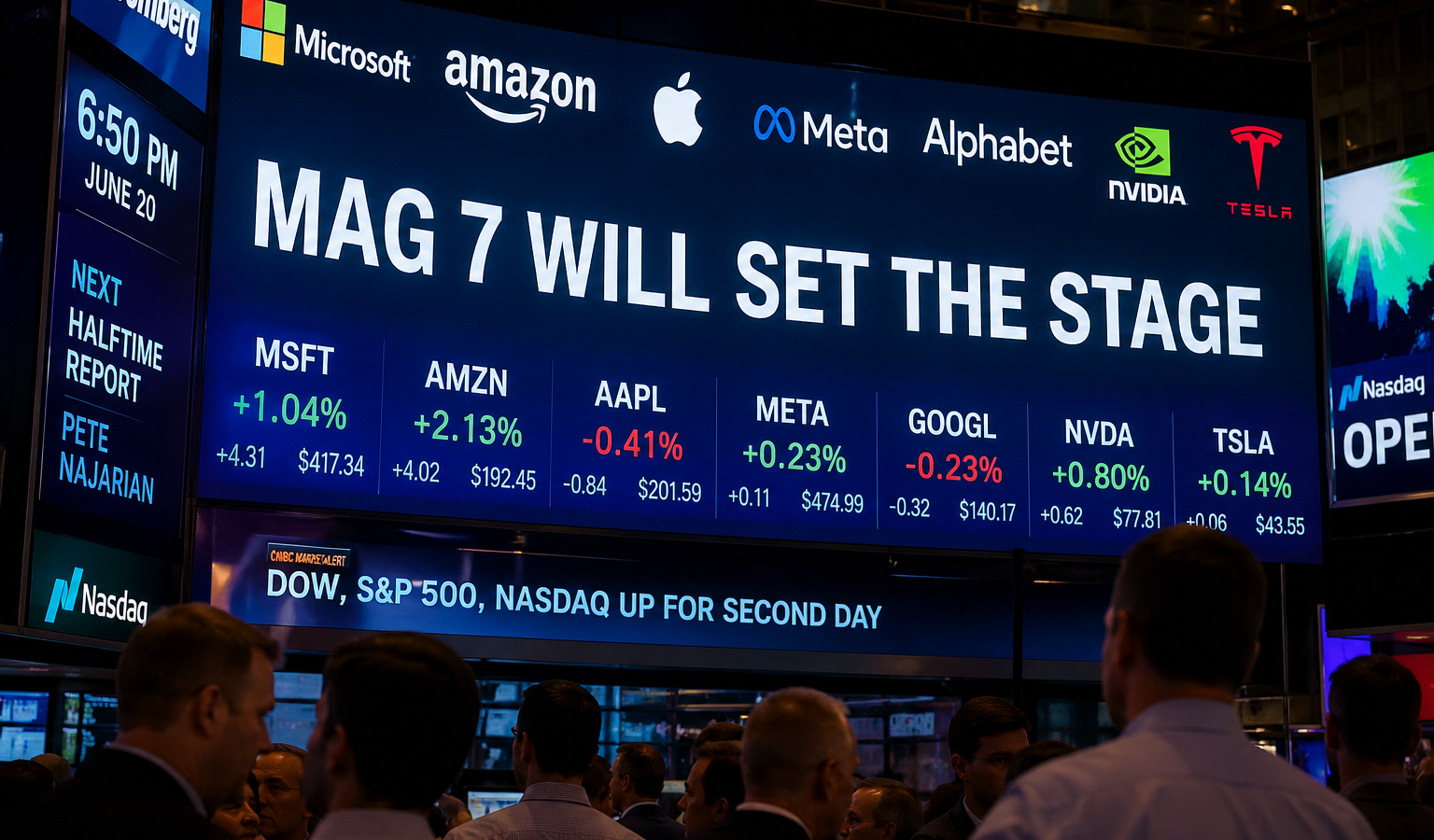
The Mag 7 Will Set the Stage This Week
The market is about to get its biggest test of the year, and most investors don’t realize it. This week — Monday April 27 through Friday May 1 — is the single busiest earnings week of the entire reporting season. Five of the Magnificent Seven report inside of 48 hours of each other:
Wednesday after the close: Microsoft, Amazon, Alphabet (Google), and Meta — all four on the same day.
Thursday after the close: Apple.Together, these five names represent roughly a quarter of the entire S&P 500’s market value. Whatever they say — and more importantly, whatever they guide for the next quarter — will set the stage for whether this rally has another leg in it, or whether we’re due for a sharp pullback. Here’s the setup. You need to understand it before you do anything else this week.
These Stocks Are Not Cheap. They’ve Been Running Going into their earnings reports, Microsoft, Amazon, Meta, and Alphabet are each up more than 10% just in the month of April alone. Apple is up over 6%. The Roundhill Mag 7 ETF, which tracks all seven of these names as a basket, is up 13% on the month versus 9% for the broader S&P 500.That kind of run into a known catalyst means expectations are sky-high. The bar to clear isn’t simply “beat earnings estimates” — it’s beat AND raise forward guidance, or the stocks can sell off even on a good number. This is what Wall Street calls “sell the news” risk. There’s an old expression that captures it: buy the rumor, sell the news. When stocks run up hard going into a known event, the event itself often becomes the moment buyers take their profits. Even strong earnings can produce a red close — because the good news was already priced in three weeks ago.
But Here’s the Other Side
The Mag 7 are projected to grow earnings 25% this year versus just 11% for the rest of the S&P 500. They are still the engine of this market. Through last Friday, 77% of the S&P 500 companies that have already reported are beating estimates. That’s a strong setup. If the Mag 7 confirm what we’ve been seeing from the rest of corporate America — solid revenue, disciplined spending, and confident guidance — the rally has plenty of fuel for another leg higher.
If they disappoint, even one of them, you’ll see the profit-taking spread across the entire index in a hurry.
What I’m Watching Specifically
1. Microsoft is the bellwether of the group. It has been the laggard of the Mag 7 this year. The market wants to see Azure cloud growth re-accelerate above 27%. If MSFT delivers, it lifts the whole group. If it disappoints — especially if it loses its 200-day moving average — every other tech name gets pulled down with it.
2. AI capital spending discipline. These five companies have collectively pledged hundreds of billions of dollars on AI infrastructure. Wall Street wants discipline, not blank checks. Any company that shows a path to monetizing that AI spend gets rewarded. Any company that raises capex again without showing the revenue to back it up gets punished.
3. Forward guidance over headline numbers. The Q1 number that prints Wednesday and Thursday matters less than what management tells you about Q2 and the rest of 2026. The market trades the future, not the past. Listen to the conference calls, not just the headlines.
4. The IV crush. Implied volatility — basically the price of options — is jacked up going into these prints. Even on a beat, you often see the option-related hedging unwind knock the stocks 2-3% lower the day after. Don’t panic if you see green numbers in after-hours trading turn red the next morning. That’s mechanical, not fundamental.
Bottom Line for This Week
The Mag 7 will set the tone for the entire month of May. A clean sweep of beats with raised guidance, and the rally extends. Breadth stays healthy. We grind higher. A mixed bag — even one ugly print from Microsoft or a soft guide from Apple — and you’ll see the profit-taking spread fast.
With these five names representing roughly 25% of the S&P 500’s market cap, what they do this week IS what the market does this week.
Now, with that stage set — let’s talk about what the tape is telling us underneath all the noise.
Cutting Through the Noise
Every morning the financial media has a new reason for you to be terrified. War headlines. Tariff threats. Oil shocks. Fed surprises. And every afternoon, somehow, the market keeps grinding higher. If you’ve been sitting on the sidelines waiting for the next shoe to drop, you’re not alone — and you’re also missing what the market is actually doing underneath the surface.
So let’s do something simple. Let’s stop reading the news and start reading the tape. Because the tape doesn’t lie. The tape tells you what the smartest money in the world is actually doing with real dollars — not what some talking head thinks might happen next quarter. Here’s what I’m seeing as of right now, in plain English.
The Trend Is Up — And It’s Not Even Close
Think of moving averages like the speed limit signs on a highway. There are three big ones traders watch: the 5-day, the 50-day, and the 200-day. When the market is trading above all three, and they’re stacked in order from fastest to slowest, that’s what we call a bullish staircase. It tells you the trend is up across every timeframe — short-term, medium-term, and long-term.
Right now, the S&P 500 is doing exactly that. The index recaptured the 7,000 level after the late-March selloff during the Iran conflict, and it has been grinding higher ever since. The bears took their best shot. They couldn’t hold it. That’s what we call a failed breakdown — and historically those are some of the most powerful bullish signals in the book. When the market refuses to go down on bad news, that’s the news
Momentum: Plenty of Gas Left in the Tank
Here’s a number most people don’t understand — the RSI, or Relative Strength Index. Think of it like a fuel gauge. It runs from 0 to 100. Below 30 means oversold (the market is on empty and probably needs to bounce). Above 70 means overbought (the market has been running hot and is due for a breather). Right now the RSI is sitting in the mid-50s — smack in the middle of the fairway.
Translation: the rally is not exhausted. The market has room to run higher before it gets dangerously stretched. This is exactly the kind of reading you want to see if you’re looking to buy pullbacks rather than chase tops.
The VIX Is Telling You Fear Has Evaporated
The VIX is the market’s fear gauge. When investors are scared, they buy protection (puts), and the VIX rises. When they’re complacent, the VIX falls. During the Iran shock and tariff panic, the VIX spiked into the 30s. Right now? It just closed at 19.31. That’s a 25% drop in a single month.
Now here’s where I have to be honest with you. A low VIX is not the green light most people think it is. When the VIX gets crushed this fast, it doesn’t mean the danger is gone — it means the market has stopped pricing the danger. And that’s precisely when the next surprise headline hurts the most. Nobody is hedged. Everybody is leaning the same way.
This is the part that matters for our newsletter family: the market is still nervous about the war. Make no mistake. The Iran ceasefire is a suspension, not a resolution. Every good headline out of the Middle East lifts this market. Every adverse headline knocks it down. And every uptick in the price of crude oil rattles the inflation narrative all over again — because higher oil prices mean higher inflation, which means a Fed that can’t cut rates, which means trouble for the rally.
Watch the VIX. If it starts ticking back above 20 on rising volume, that’s your warning. That’s the moment the complacency trade ends and the headline risk starts pricing back in.
The Generals AND the Troops Are Marching
Here’s a critical concept most retail investors miss. A market index is just a number — it can be pushed higher by a small handful of giant stocks while everything else underneath is rotting. We saw that for most of 2024 and early 2025. The Mag 7 carried the index while hundreds of other stocks were quietly bleeding.
That’s not what’s happening now. The advance/decline line — which simply counts how many stocks are going up versus going down each day — is rising right alongside the index. The troops are marching with the generals. That’s a healthy tape. It tells you this rally has broad participation, not just five tech names doing all the heavy lifting. When you see breadth confirming price like this, the rally has staying power.
The Coiled Spring: Why Margin Debt Matters
Margin debt is the money investors borrow against their portfolios to buy more stock. When margin debt is rising, it’s fuel for the rally. When it’s falling, it usually means investors are being forced to sell to pay down those loans.
During the Iran shock, margin debt declined for two months straight. Translation: leveraged accounts got hit hard, took their lumps, and were forced to lighten up. That deleveraging is now a coiled spring. As the market stabilizes and rises, those same accounts start re-borrowing and re-buying. New margin debt is new buying power. It’s one of the quietest, most reliable engines of a continuing rally.
Where Does the Buying Come From Next?
This is the question that matters most. Every rally needs fuel. Here’s where I see the buying coming from over the next several weeks, in order of importance:
1. Short Covering. Plenty of bears bet against this market on the war fears and the tariff panic. As the market keeps refusing to break down, those shorts have to cover. That’s mechanical buying that has nothing to do with conviction — it’s pain.
2. Computer-Driven Buying (CTAs). These are the trend-following algorithms that big institutions run. They don’t have opinions — they just follow rules. The rule is simple: when the market trades above its key moving averages, buy. The market is now well above those levels, and these machines are mechanically adding exposure every day.
3. Corporate Buybacks. Companies are coming out of their earnings blackout windows over the next few weeks. Buyback authorizations are at all-time highs. This is the most consistent, non-emotional bid in the market — companies buying back their own stock no matter what retail or institutions are doing.
4. Re-Leveraging. As I mentioned, the margin spring is coiled. Those accounts will lever back up as conditions stabilize.
There’s also been a lot of talk about the $7 trillion sitting in money market funds being a giant pool of dry powder. I want to push back on that one. Most of that money is what I call money market money — it’s there because the people who own it want to be there, earning 4-5% safely. History tells us most of that money does not chase the stock market. A small slice rotates back in. Don’t bet on a tidal wave.
The Bottom Line
The tape is healthier than the headlines suggest. The trend is up. Momentum has room. Breadth is confirming. Margin is set up to re-lever. The fuel sources for continuation are real.
But here’s the catch — and you need to hear this. This market is still nervous about the war. It’s pricing in a soft landing, a trade resolution, and a contained Iran situation. Any deviation from that script is your correction trigger. The market will react to good headlines (it lifts), it will react to adverse headlines (it drops), and it will react every single time the price of oil pushes higher. Crude is the inflation transmission belt. When oil rises, the whole rally narrative gets challenged.
Layer on top of all of that the five Mag 7 prints landing this week, and you have the makings of either the next leg up or the first real test of this rally’s legs. By Friday’s close, we’ll know which one it is.
So what do you do with this?
Don’t chase the rips. Buy the dips. Trend is your friend. Stay in your highest-conviction names. Trim what’s gotten extended. Keep some powder dry for the inevitable headline pullback or the post-earnings shakeout. And pay attention to the VIX, the price of crude oil, the Mag 7 reactions Wednesday and Thursday after the close, and any breaking news out of the Middle East — because those are the four things most likely to flip the script in a hurry.
The market gives you the signals. Your job is to listen to them — not to the noise.
“Don’t dream what you want to do. Do what you dream.
Living is about memories, not dreams.
And there’s always room for another good memory.”
ourtradedesk.com