
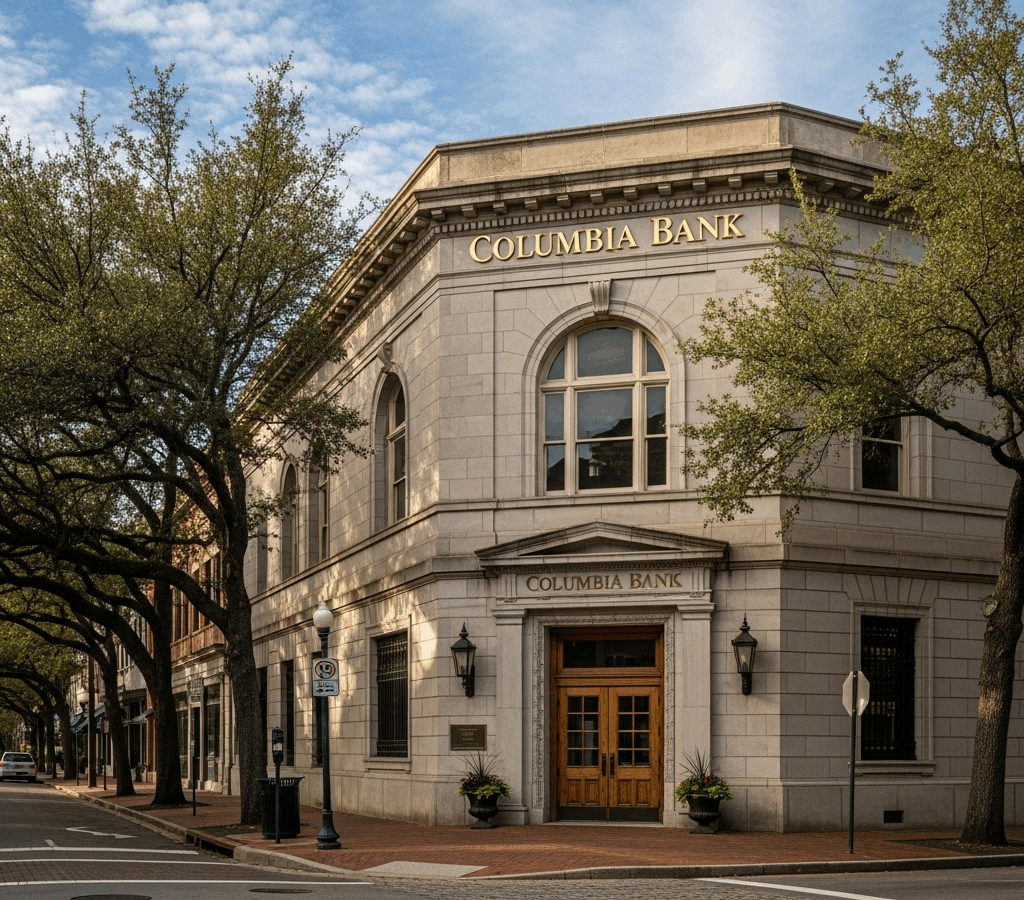
Columbia Bank: 02/08/2026
● 📅 Initial Buy Recommendation: November 10, 2024 at $27.93
● 📅 Reiterated Buy Recommendation: July 26, 2025 at $24.82
💰 Average Entry Price: cost $24.93 (dividends included)
I take a methodical approach to building positions — sometimes not buying all at once. Instead, I enter long-term plays in stages, often more than twice, especially when market conditions drive stocks I like long term lower. Price compression isn’t panic; it’s preparation. I’m not chasing. I’m building. This is how asymmetric returns are made, especially when a generous dividend is included.
Columbia Banking System (COLB) represents a compelling value opportunity in the Western U.S. regional banking space. Following its transformative acquisition of Pacific Premier Bancorp, which closed on August 31, 2025, the company has scaled into a $66.8 billion asset franchise spanning nine states across the Western U.S. The stock trades at just 12.8x trailing earnings with a nearly 5% dividend yield, meaningfully below its fair value given its earnings trajectory, expanding net interest margin, and significant deregulatory tailwinds.
Q4 2025 Earnings Review: Fourth Consecutive Beat
Columbia reported Q4 2025 results on January 22, 2026, delivering yet another quarter of beats across the board. This marked the fourth consecutive quarter in which the company surpassed both EPS and revenue consensus estimates, underscoring management’s execution credibility.
Q4 2025 Key Metrics
CEO Clint Stein noted:”Our fourth quarter performance marked a strong end to a tremendous year for Columbia, reflecting continued momentum across our businesses and our commitment to consistent, repeatable results.“
Net interest income surged 43.4% year-over-year to $627 million, driven by the full-quarter contribution of Pacific Premier, declining deposit costs, and the reduction of higher-cost wholesale funding. The NIM expanded 42 basis points year-over-year to 4.06%, and management expects NIM to continue trending higher through 2026, potentially surpassing 4% consistently by mid-year. Non-interest income rose to $90 million, up $13 million sequentially, aided by fair value gains and growing fee income contributions from card-based fees, treasury management, trust services, and the newly acquired HOA banking and 1031 exchange platforms from Pacific Premier.
The revenue and earnings growth story at COLB is multi-layered. On a GAAP basis, FY2025 revenue grew approximately 28% year-over-year, driven by the Pacific Premier acquisitionadding roughly $15.6 billion in assets to the balance sheet. Operating EPS grew 15% year-over-year from $2.71 to $3.12, beating the consensus estimate of $3.02. Critically, this growth is not merely acquisition-driven—organic net interest income improvement was substantial, with NIM expanding from 3.64% in Q4 2024 to 4.06% in Q4 2025, a 42 basis point improvement reflecting genuine operational efficiency.
Quarterly EPS Progression — 2025
Looking ahead to FY2026, consensus estimates project revenue of $2.92 billion and EPS of $3.09. However, given the company’s consistent pattern of beating estimates—four consecutive quarters in 2025 with an average beat of 16%—actual results could meaningfully exceed these figures. Revenue is forecast to grow approximately 19% annually over the next three years, well above the 7.7% growth forecast for the broader U.S. banking industry.
Valuation Analysis: Compelling Discount
COLB trades at a P/E of 12.8x trailing earnings, which screens as attractively valued against multiple benchmarks. The S&P 500 trades at roughly 21–22x earnings, while the KBW Regional Banking Index trades closer to 14–15x. COLB’s discount to peers is unwarranted given its above-peer NIM trajectory, scale advantages as the largest bank headquartered in the Pacific Northwest, and the accretive nature of the Pacific Premier merger.
Valuation Metrics:
On a forward P/E basis using the 2026 consensus of $3.09, COLB trades at just 9.5x—a significant discount to the regional bank peer group. The stock also trades at approximately 1.16x book value ($25.41 as of Q2 2025) and 1.54x tangible book ($19.11 as of Q4 2025). Applying a modest 11x multiple to estimated 2026 operating EPS of $3.09 yields a price target of $34.00, representing approximately 15% upside from current levels before the ~5% dividend yield. Total return potential approaches 20%.
Dividend Analysis: Robust Income Story
COLB has maintained consecutive dividend payments for 29 years, demonstrating a deep institutional commitment to shareholder returns. The current quarterly dividend of $0.37 per share ($1.48 annualized) translates to a yield of approximately 5.0% at current prices—one of the most attractive yields in the regional banking sector, ranking in the 81st percentile among U.S. equities and the 85th percentile within its sector.
The payout ratio stands at approximately 63% of trailing earnings, which is sustainable and leaves ample room for continued dividend growth as earnings expand through 2026 and beyond. The recently increased quarterly dividend (from $0.36 to $0.37 per share) signals management’s confidence in the earnings outlook. Additionally, the Board authorized a $700 million share repurchase program in Q3 2025, adding a second powerful capital return lever.
During Q4 2025, the company repurchased 3.7 million shares at an average price of $27.07, demonstrating that management views the current valuation as attractive—a bullish signal that aligns with our thesis.
Banking Sector S&P 500, Deregulation: Powerful Tailwinds
The U.S. banking sector is entering one of the most favorable regulatory environments in over a decade. The Trump Administration’s deregulatory agenda, combined with a Republican-controlled Congress, is creating material tailwinds for regional banks like COLB across multiple dimensions.
Capital Requirements Easing: In November 2025, the FDIC and other federal regulators finalized rules easing the enhanced supplementary leverage ratio (eSLR) for the largest
institutions and lightening capital obligations for smaller banks. Capital requirements at major bank subsidiaries could fall by approximately 27%, freeing approximately $213 billion industry-wide. This is only the opening move—additional capital changes are expected in 2026 as Basel III Endgame rules are finalized in a more capital-neutral form.
M&A Acceleration: 2025 was a banner year for bank consolidation. The easing of merger review timelines and flexible regulatory standards is spurring further consolidation, with larger regional banks acquiring smaller institutions to build scale. COLB’s Pacific Premier acquisition is a textbook example of this trend. Treasury Secretary Scott Bessent’s advocacy for deregulation has further accelerated dealmaking.
Reduced Compliance Burden: Regulators are refocusing examinations on material financial risk rather than governance formalities and reputational risk. The OCC and FDIC issued a proposed rule that would formalize this shift. The CFPB is being scaled back, reducing compliance costs for consumer-facing lending operations. The Fed has announced a 30% staffing cut to its supervision division.
Digital Assets: Innovation:Banking regulators have reversed Biden-era restrictions on digital asset services, opening new revenue opportunities for banks willing to serve the crypto and fintech ecosystem. The GENIUS Act requires comprehensive stablecoin frameworks by July 2026, creating potential new fee income streams for well-positioned banks.
Loan Growth Revival: The rollback of leveraged lending guidance is designed to restore bank participation in corporate credit. Weekly H.8 data showed seven consecutive weeks of loan growth as of late 2025, the longest such streak since Q2 2022. U.S. large banks with approximately $200 billion in excess capital are positioned to deploy that capital for growth, and COLB’s $67 billion balance sheet gives it the scale to compete effectively.
For COLB specifically, deregulation is a triple benefit: lower compliance costs improve operating efficiency, easier M&A pathways support the company’s growth-through-acquisition strategy, and reduced capital requirements free cash for dividendsand buybacks. The company is already realizing these benefits—the Pacific Premier deal received regulatory approval and closed smoothly, and the $700 million buyback authorization reflects capital flexibility that the deregulatory environment supports.
Key Catalysts
Pacific Premier Systems Conversion (Q1 2026):</strong> Full cost synergy realization expected by June 30, 2026, which should bring operating expenses to a normalized run rate of $335–$345M per quarter and meaningfully expand profitability.
NIM Expansion: Through 2026: Management expects NIM to trend higher each quarter as deposit repricing continues, wholesale funding is reduced, and the $8 billion transactional multifamily loan book is remixed into higher-yielding relationship loans.
Cross-Sell Revenue Synergies: Over 1,200 cross-sell referrals generated since Pacific Premier closing, with HOA banking, custodial trust, escrow, and 1031 exchange businesses adding diversified fee income.
Share Repurchase Execution: $700M authorization at current valuation levels is highly accretive, supporting EPS growth independent of organic factors.
Risk Factors
Integration Execution: Systems conversion and branch consolidation during Q1 2026 carries operational risk. Elevated non-interest expenses ($412M in Q4 vs. $278M in Q2) reflect merger costs that must normalize.
Credit Quality:FinPac small-ticket leasing has shown elevated charge-offs, and office CRE loans represent 8% of total loans. Net charge-offs were 0.32% annualized in Q1 2025—manageable but worth monitoring.
Tariff & Macro Uncertainty: Trade policy uncertainty could weigh on business confidence and loan demand in COLB’s Western U.S. footprint. However, the region’s household income at 106% of the national average provides a buffer.
Activist Pressure: HoldCo Asset Management ($2.6B AUM) released a presentation on COLB in late 2025 but indicated no proxy contest for 2026. This could be a positive catalyst if management accelerates value-creation initiatives in response.
TL;DR Bottom Line– If you are a conservative investor and like dividends this more than likely is your cup of tea. I don’t see the upside I like at 32$ even as activists push for higher returns. Although it could be a possible takeover target and benefits from deregulation, Columbia Bank has remained on my buy list for over a year. With dividends it has returned approximately 29%. I liked it better in the mid 20’s.
Columbia Banking System offers a rare combination of value, income, and growth in the current market. At 12.8x trailing earnings and 9.5x forward earnings, the stock is pricing in none of the upside from Pacific Premier synergies, continued NIM expansion, or the broader deregulatory tailwind. The nearly 5% dividend yield provides downside protection and income while you wait, supported by 29 consecutive years of payments and a 63% payout ratio that leaves room for growth. Four consecutive quarters of earnings beats demonstrate management’s credibility and execution capability.
Institutional investors are taking notice—JPMorgan Chase added over 4 million shares (+221%) in Q1 2025, Vanguard added 8.7 million shares (+41%) in Q3, and BlackRock added 7.9 million shares (+42%) in Q3. Analysts project a median price target of $29.50 with a high of $35.00 (Piper Sandler: $33.00).
Rating: I like the stock, love the dividend, deregulation should help and it is in a good sector for 2026. The upside from 32$ is going to be slow. It’s your choice.
🔒 Disclaimer & Disclosure Statement
IMPORTANT – READ CAREFULLY:
The content provided in this newsletter (hereafter referred to as “the Newsletter”) is for informational and educational purposes only. It does not constitute investment advice, financial advice, trading advice, or any other form of personal or professional advice. You should not rely solely on the information provided herein to make investment decisions.
Business Structure and Professional Status
This Newsletter is published by a publishing and content company engaged in the business of providing financial commentary, market analysis, and educational content. I am not a licensed financial advisor, investment advisor, broker-dealer, or registered representative. While I was previously a licensed stockbroker for over 25 years, I currently hold no active securities licenses or professional financial designations. My opinions are solely my own and reflect my personal market views and trading activity. I frequently hold positions in the securities I discuss and may buy or sell shares at any time, including before or after publication. Any such ownership will be disclosed, but this does not constitute a recommendation for you to act similarly. My positions may create actual or perceived conflicts of interest.
Regulatory Status
This Newsletter is not subject to oversight by the U.S. Securities and Exchange Commission (SEC) or any other regulatory body, as I am not a registered investment advisor orbroker-dealer. The Newsletter operates outside the regulatory framework that governs registered financial professionals.
No Fiduciary Duty
I have no fiduciary duty to any reader or subscriber of this Newsletter. The information provided is general in nature and is not tailored to the investment objectives, financial situation, or risk profile of any individual.
Not a Solicitation
This Newsletter is not a solicitation to buy or sell any security. Any mention of a security, company, or financial instrument is for illustrative and commentary purposes only.
Forward-Looking Statements and Projections
All forward-looking statements, market predictions, price targets, and financial projections are based on assumptions, current expectations, and available information, and are subject to risks, uncertainties, and changes without notice. Such statements are highly speculative in nature and should not be relied upon as factual representations of future events. Market conditions can change rapidly and unpredictably. Past performance is not indicative of future results.
Compensation and Independence
As a publishing and content company, I receive no compensation from any company, issuer, or third party for the securities I discuss. My only compensation comes from paid subscriptions to this Newsletter and other content-related business activities.
Investment Risks
Investing in stocks and other securities involves substantial risk, including the risk of loss of capital. You are solely responsible for your own investment decisions. You should consult with a licensed financial advisor, tax professional, and/or attorney before making any investment or financial decisions.
Information Sources and Accuracy
The content in this Newsletter is provided “as is” without any warranties or guarantees, expressed or implied. No representation is made as to the accuracy, completeness, or timeliness of any information contained herein. While I strive for accuracy, information obtained from third-party sources, including company reports, news services, and market data providers, may contain errors or omissions for which I cannot be held responsible. All content is subject to change without notice.
Geographic Limitations
This Newsletter is intended primarily for residents of the United States and is prepared in accordance with U.S. securities laws and regulations. International readers should consult with local legal and financial professionals to ensure compliance with applicable laws in their jurisdiction before acting on any information contained herein.
Technology and Delivery Risks
Electronic delivery of the Newsletter may be subject to technical failures, delays, or interruptions beyond our control. While we strive for reliable delivery, we cannot guarantee the timeliness or successful delivery of all communications.
Subscription Terms
This Newsletter and its contents are intended solely for the personal use of paid subscribers and may not be redistributed, reproduced, forwarded, or republished in any form without the publisher’s prior written consent. Subscription cancellation and refund policies, if any, are governed by separate terms of service.
Legal Compliance and Official Filings
All readers are strongly encouraged to review official company filings, including those available at the U.S. Securities and Exchange Commission (SEC) website, and to conduct independent research before making any investment decisions.
Indemnification
You agree to indemnify and hold harmless the publisher, its affiliates, contributors, and employees from any and all liability, loss, or damages that may arise directly or indirectly from your use of the Newsletter.
By reading and subscribing to this Newsletter, you acknowledge that you have read, understood, and agree to be bound by the terms defined herein.