
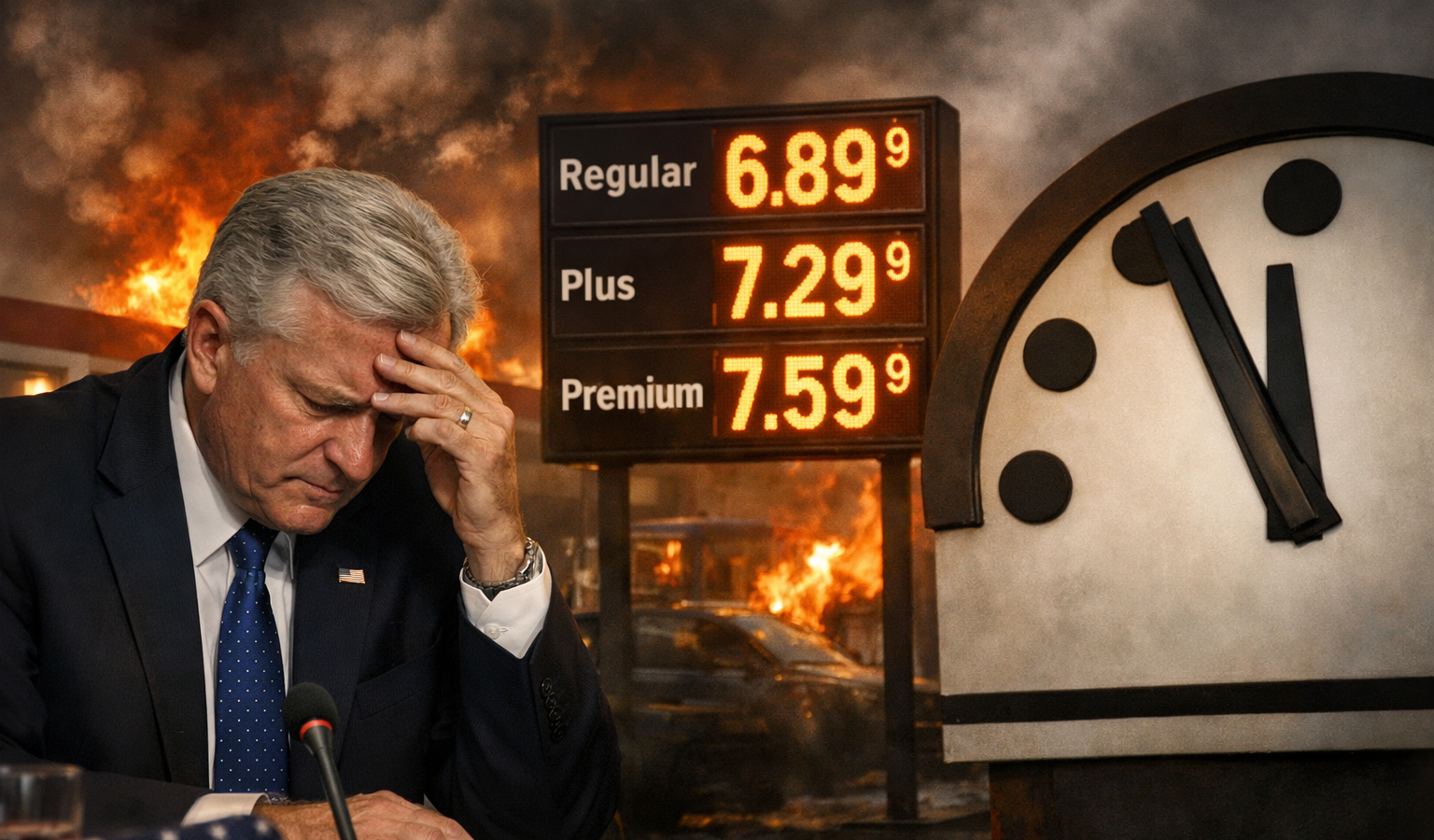
THE OIL CLOCK, THE INFLATION
CLOCK,
AND THE POLITICAL CLOCK
How the Iran War, Oil Prices, and the 2026 Midterms Are on a Collision Course
“Don’t dream what you want to do. Do what you dream. Living is about memories, not
dreams. There is always room for another good memory.
“
Editor note: The market could bounce on any breakthrough or because it is
oversold. Don’t get excited, the damage it has caused needs to be repaired.
Where We Stand Right Now
As I write this, Brent crude sits at roughly $107 per barrel and WTI is trading around
$95. Before the U.S. and Israel launched joint strikes against Iran on February 28,
Brent was at $71. That is a 50%+ spike in under three weeks.
The national average for diesel has rocketed to $5.04 per gallon according to AAA as
of March 17, up from $3.76 before the conflict started. Regular gasoline is above $3.84
nationally, its highest level since September 2023.
The International Energy Agency has called this the largest oil supply disruption
in the history of the global oil market. Nearly 20 million barrels per day of crude
and product exports through the Strait of Hormuz have been disrupted. Production
across Iraq, Kuwait, the UAE, Saudi Arabia, and Qatar has been curtailed by at least 8
million barrels per day, with an additional 2 million barrels of condensates and NGLs
shut in.
This report addresses three questions that are now inseparable from one another: How
long can oil stay this elevated? When does the American consumer actually feel relief?
And how long can the White House sustain a war that is bleeding its party heading into
the midterm elections?
The answer to all three converges on the same window.
Part I: The Oil Supply Problem
Why Supply Cannot Catch Up Quickly
The administration assumed a quick strike, rapid Iranian capitulation, minimal oil
disruption. That assumption was wrong. Here is why the supply response is measured in
months, not weeks.
The Strait of Hormuz Cannot Just Reopen
Even if a ceasefire were announced tomorrow, tanker companies need marine war risk
insurance reinstated, physical escort guarantees from the U.S. Navy or allied forces, and
mine-clearance verification before they will send vessels back through the Strait. That
process alone takes weeks. As of this writing, Iran’s new supreme leader, Mojtaba
Khamenei, has publicly vowed to keep the Strait closed. Energy Secretary Chris Wright
has acknowledged that the U.S. Navy is not yet ready to escort tankers through.
Gulf Producers Need Restart Time
When oil fields are shut in for extended periods, the restart is not a light switch.
Reservoir pressure maintenance, waterflooding system management, safety protocols,
and gradual production ramp-up are all required to prevent formation damage. The
IEA’s March 2026 assessment notes that a major offshore field producing 500,000
barrels daily might require three to four weeks of careful restart procedures, initially
ramping at just 50,000 barrels daily before reaching full capacity. Multiply that across
every shuttered field in the Gulf and you are looking at six to eight weeks from ceasefire
to full production recovery.
Emergency Reserves Are a Band-Aid
On March 11, the IEA announced the largest emergency stockpile release in its 50-year
history: 400 million barrels across 32 member countries, with the U.S. contributing 172
million barrels from the Strategic Petroleum Reserve. It sounds massive. It is not
enough.
The U.S. release will take 120 days to complete, which translates to roughly 1.4 million
barrels per day. That is only about 15% of the supply lost due to the Hormuz closure.
Rystad Energy’s Tom Liles put it plainly: there is only a limited amount of volume that
can be released over a given period. It is not as if 400 million barrels just appear
immediately on the market. Raymond James estimates it could take 60 to 90 days
before this oil meaningfully reaches the market.
Crude prices continued to climb even after the IEA announcement, underscoring that
traders view this as insufficient.
U.S. Shale Will Not Ride to the Rescue
Shale producers had budgeted for WTI prices in the $55 to $60 range. They are not
going to tear up capital plans on a war that might end next month. As veteran analyst
Dan Pickering wrote, today’s public E&P companies are no longer cowboys willing to
blast off billions in capex because of a hunch. Capital discipline, investor payouts, and
bolstering balance sheets remain priorities.
Even if companies added rigs today, the lead time from spudding a well to first
production in the Permian is four to six months. Rystad estimates U.S. producers could
add roughly 200,000 barrels per day over the course of 2026, but that is not their base
case. Against an 8 to 10 million barrel per day disruption, it is a rounding error.
Bypass Infrastructure Is Limited
The EIA estimates only about 2.6 million barrels per day of pipeline capacity exists to
bypass the Strait of Hormuz through Saudi and UAE pipelines. Against 20 million
barrels per day of lost transit, that covers roughly 13%.
The EIA’s Price Forecast
The EIA’s March 2026 Short-Term Energy Outlook projects that Brent will remain
above $95 per barrel through May, then fall below $80 in Q3 2026 and reach
around $70 by year-end. Critically, this forecast assumes the Strait gradually
reopens. If it does not, the entire curve shifts higher and further out.
Once flows are reestablished, the EIA expects global oil inventories to increase by an
average of 1.9 million barrels per day through 2026 and by 3.0 million barrels per day in
2027. Before this war, the market was structurally oversupplied. The IEA had previously
forecast a surplus of 3.73 million barrels daily for 2026. That bearish fundamental
backdrop has not disappeared. It has been temporarily overwhelmed by the largest
supply shock since the 1970s.
Part II: Two Scenarios for Consumers
Scenario 1: Oil Above $100 Through End of March
If the Strait begins reopening in April, the EIA’s base case roughly holds. Oil starts
declining meaningfully by June, breaks below $80 by July or August, and approaches
$70 by December. Under this timeline:
Oil below $100 (Brent): Late May to June 2026.
Oil below $80 (Brent): July to August 2026.
Diesel below $4 per gallon nationally: October to November 2026.
Consumer pump relief begins: August 2026.
The EIA’s March STEO projects the U.S. on-highway diesel price will average $4.12 per
gallon for all of 2026 and $3.78 per gallon in 2027. That tells you that even with a
relatively optimistic resolution, the annual average for diesel stays above $4 this year.
Scenario 2: Oil Above $100 Through End of April
An additional month of Hormuz closure triggers cascading structural damage.
Emergency reserves get meaningfully depleted. Extended production shutdowns cause
formation damage that impairs restart capacity. Demand destruction kicks in across
Asia but moves slowly in the United States because we are a net exporter and
geographically insulated. Refining bottlenecks intensify because many U.S. Gulf Coast
refineries are configured for heavy crude from Canada and the Middle East, not the light
crude produced in the Permian.
Oil below $100 (Brent): July 2026.
Oil below $80 (Brent): October to November 2026.
Diesel below $4 per gallon nationally: Q1 2027.
Consumer pump relief begins: November to December 2026.
As ING strategists put it: the only way to see oil prices trade lower on a sustained basis is
by getting oil flowing through the Strait of Hormuz. Failing to do so means the market
highs are still ahead of us.
Why Consumers Are Always the Last to See Relief
Every step in the supply chain adds latency. Crude production restarts take three to six
weeks after the Strait reopens. Tankers scattered globally need to reposition, and
insurance must be reinstated. Transit to consuming markets takes two to four weeks by
sea. Refining crude into diesel, gasoline, and jet fuel adds more time. Wholesale pricing
adjusts two to four weeks after refinery margins normalize.
And then there is the well-documented “rockets and feathers” effect: gas prices
shoot up like rockets when oil rises but fall like feathers when oil drops. Research from
North Carolina State University found that gas prices fall twice as slowly as they rise
after a major oil price change. If it took four weeks for prices to increase 25 cents, it
takes eight weeks to fall 25 cents once oil returns to its starting level.
The St. Louis Federal Reserve has confirmed this asymmetry. Retailers price off
replacement cost, compress margins on the way up, and recover those margins slowly
on the way down. Consumers who are relieved that prices are finally dropping do not
shop around as aggressively, handing pricing power to fuel retailers.
Net result: even after crude oil sustainably breaks below $80, consumers should expect
eight to twelve weeks before diesel at the pump reflects those lower input costs at a
national level.
Part III: The Inflation Timeline
The Calm Before the Storm
The February CPI came in at 2.4% year-over-year, reported on March 11. This was
the last clean read. The data predates the oil shock entirely. As Carson Group’s chief
macro strategist said: this is the calm before the storm that will show up due to surging
gasoline prices in March.
The March Spike
EY estimates headline CPI will rise 0.9% month-over-month in March, with
gasoline prices up roughly 15%, pushing headline CPI inflation toward 3.3%. That is a
massive one-month jump from 2.4%. This print will be released on April 10 and will
dominate headlines.
The Sustained Damage If Oil Stays Elevated
Economists at Wolfe Research, reported by CNBC, estimate that if a longer conflict
keeps U.S. oil prices averaging about $100 per barrel for the rest of the year, CPI
inflation would rise to 3.5% by year-end. RBC Economics calculated that a sustained
$100 per barrel reality would keep headline CPI above 3% through all of 2026.
Why Inflation Lags Oil on the Way Down
This is the part most people miss. Even when oil drops, inflation does not drop with it.
There are three layers of lag.
Layer 1 — Oil to gasoline and diesel (2 to 4 weeks). Crude must be refined,
transported, and repriced at wholesale. On the way up, this happens in days. On the way
down, retailers adjust slowly.
Layer 2 — Energy to broader CPI (1 to 3 months). Rising diesel costs flow
through to trucking, which flows through to food transport, which flows through to
grocery prices. Rising jet fuel costs filter into higher airfares. More expensive diesel
feeds into elevated food prices. These second-order effects take 30 to 90 days to show up
in the CPI data and even longer to reverse because businesses that raised prices are
reluctant to cut them.
Layer 3 — CPI reporting lag (1 month). CPI data for a given month is not released
until about four weeks later. Even if oil collapses in July, consumers will not see it
confirmed in the data until the August or September report.
When Does Inflation Noticeably Come Down?
If the Strait reopens by May and oil falls below $80 by July or August (the EIA base
case), then the March through June CPI prints will all be elevated in the 3.0% to 3.5%
range. July would start showing some easing, but the second-order effects in food,
transport, and airfare stay sticky.
The first CPI print that would show noticeable, across-the-board relief would likely be
the September data (released in October) or the October data (released in
November). But consumers actually feeling relief at the grocery store and the pump is
more like November to December 2026.
If the war extends through April, push everything four to six weeks deeper, meaning
noticeable inflation relief would not show up until the November or December CPI
prints.
Part IV: The Political Clock
The White House Approval Is in Free fall Among the Voters
Who Matter
A Daily Mail/JL Partners poll conducted March 18 to 20 shows The White House
approval at 42%, the lowest level recorded in that survey series. He was at 44% on
March 3, just days into the war, and at 48% in late January. That is a 6-point drop in
under two months, accelerating since hostilities began.
More critically, the Economist/YouGov poll shows Trump’s Iran War approval dropped
20 points among independent voters in a single week. Only 24% of independents now
approve of his overall job performance, while 63% disapprove.
Quinnipiac found 53% of voters oppose U.S. military action in Iran, with independents
opposing it 60% to 31%. The Marist/NPR/PBS poll showed 59% of independents
disapprove of how Trump is handling Iran, up from 49% during the 2020 Soleimani
strike. Independent voters are the ball game in a midterm. Trump carried them in 2024.
He is hemorrhaging them now.
Gas Prices Are the Dominant Pocketbook Issue
In the Daily Mail/JL Partners poll, 44% of respondents cited inflation as their primary
grievance with Trump, up from 38% at the start of March. Another 28% cited the Iran
war specifically, up from 20%. And here is the devastating number for the White House:
54% of voters said they would blame Trump if gas prices rise further because of the
conflict. Only 20% would fault Iran.
Pollster Scott Rasmussen’s data shows 53% of voters believe the economy is getting
worse, compared to just 23% who say it is improving. Only 24% of Americans say their
personal finances are improving, while 39% say they are getting worse. That 15-point
gap is the worst since Trump’s election. Rasmussen warns it could take up to six months
for economic sentiment to recover once conditions improve.
The Congressional Math Is Razor-Thin
Republicans hold a 218-seat House majority. Democrats need a net gain of just three
seats to flip the chamber. As of early March, 33 House Republicans have announced
they will not seek reelection compared to 21 Democrats, a historically elevated
retirement gap that signals private GOP pessimism about November.
Ballotpedia’s generic congressional vote average sits at Democrats +5 as of March 19.
Emerson College found Democrats leading 49% to 42% on the generic ballot, with an
18-point advantage among independents. The DDHQ aggregate shows Democrats at
46.0% versus Republicans at 41.1%.
Journalist G. Elliott Morris captured it precisely: “The war in Iran doesn’t need to
fracture MAGA to hurt Republicans in November. It just needs to keep soft partisans
and independents sour on the direction of the country.”
Intra-Party Fractures Are Accelerating
This is no longer just a Democratic talking point. GOP Rep. Jeff Van Drew said publicly:
we know that we are temporarily going to have higher gas and petroleum prices, but if
those prices stayed high, if we continue to have problems with the Strait of Hormuz, if
we continue to be involved in this, then it is more of an issue.
Former National Counterterrorism Center director Joe Kent resigned this week, saying
he cannot in good conscience support the ongoing war. Tucker Carlson and Candace
Owens have broken with Trump on it. Only 55% of Republicans backed the initial
action, compared to the 90%+ who supported the Iraq invasion in 2003.
The administration has floated a $200+ billion war funding request to Congress. This
forces every vulnerable Republican in a competitive district to cast a vote supporting an
unpopular war while gas prices are elevated. A great campaign ad in every swing district.
Part V: My Estimate — The War Winds Down
Between Late May and Mid-July
The White House Original Theory of the Case
The White House signaled the operation’s timeline could extend beyond four to five
weeks, meaning the original plan was a three-to-five-week air campaign, Iran
capitulates, Hormuz reopens, oil drops, political win. Barely a week after Trump hailed
falling gas prices as an economic triumph in the State of the Union, his actions sent the
cost per gallon back up. The assumption was: quick, decisive, minimal oil disruption.
That assumption was wrong.
The Five Factors That Create the Exit Pressure
Factor 1 — The inflation pain window. For the war to not destroy the midterm, oil
prices need to be trending visibly lower by July at the latest. That gives the economy
August through October to normalize before the November 3 vote. Rasmussen estimates
it could take up to six months for economic sentiment to recover. If oil is still at $100 in
July, the sentiment damage is baked into November regardless of what happens after.
Factor 2 — Independent voter hemorrhaging. Every week of elevated gas prices
compounds the loss of independents. The shift is already dramatic: independents went
from split on Trump in March 2025 to 58% saying he is not putting America first today.
Democrats hold an 18-point lead among independents on the generic ballot.
Factor 3 — GOP fractures intensify with duration. The longer the war continues,
the more Republican members in competitive districts break publicly. Kent’s
resignation, Carlson’s opposition, and the historically low 55% Republican support for
the action are all early signals. A Vietnam-style erosion is the nightmare scenario.
Columnist Jack Mitchell drew a direct comparison to 1966, when LBJ’s approval eroded
to about 45% and Democrats lost 47 House seats.
Factor 4 — The funding vote is a forcing function. A $200+ billion supplemental
request requires a congressional vote. Every vulnerable Republican must go on record.
Democrats in competitive districts are already framing this as a choice between funding
a war and funding affordability.
Factor 5 — The White House reads polls. He told the New York Post he does not
care about polling. But this is the same president who reversed course on tariffs, TikTok,
ourtradedesk.comPage 8OUR TRADE DESKMarch 2026 Special Report
and multiple other positions the moment they became politically untenable. When the
data tells him the war is costing him the House, he will move toward a resolution. The
question is whether Iran gives him an exit ramp.
The Expected Timeline
Late March through April: Continued air operations. Strait remains effectively
closed. Oil stays in the $90 to $110 range. The White House escalates military pressure
specifically aimed at degrading Iran’s ability to threaten the Strait.
May: The critical decision point. Three months of elevated gas prices will have fully
filtered into CPI data. Consumer sentiment will be cratering. The summer driving
season begins, adding seasonal upward pressure. I expect the administration to pursue
some form of ceasefire framework or mission accomplished off-ramp by late May to
mid-June.
June to July: Military operations scale down to enforcement posture rather than
active combat. The administration declares victory on the nuclear objective and pivots
messaging to getting prices down.
The absolute latest the White House can afford active operations: Mid-July.
After that, there is mathematically insufficient time for oil to decline, gas prices to fall,
CPI to normalize, and consumer sentiment to recover before November 3.
The Biggest Risk to This Estimate
Iran may not cooperate. Tehran’s new supreme leader has every incentive to keep the
Strait closed precisely because it is destroying Trump politically. If Iran calculates that
dragging this into fall costs Republicans the House, which constrains Trump’s ability to
fund the war, they will absorb the military punishment and play the long game.
In that scenario, Trump faces a terrible choice: escalate to ground troops, which 74% of
voters oppose including 52% of Republicans, or accept a protracted stalemate going into
the midterms with $4-plus gas prices.
Summary
Factor Timeline How I Got There
Oil below $100 (Brent) Late May – June EIA base case + Strait
reopening assumption
Oil below $80 (Brent) July – August EIA forecast: inventories rebuild
at 1.9M bpd once flows resume
March CPI (released April 10) ~3.3% YoY EY estimate: gasoline +15%
m/m, 0.9% headline m/m
Peak CPI 3.3% – 3.5% RBC: $100 oil keeps CPI above
3% all year
CPI starts declining noticeably Sept – Oct data 2-3 month lag from oil to broad
CPI + reporting lag
Consumers feel relief Nov – Dec 2026 Rockets & feathers: retail falls 2x
slower than rise
White House winds down ops Late May – mid-July Must give 4-5 months for
normalization before Nov 3
Absolute latest for exit Mid-July Rasmussen: 6 months for
sentiment recovery
Diesel below $4 nationally Oct – Nov 2026 EIA: annual diesel avg $4.12 for
2026
TL:DR The Bottom Line
The oil clock, the inflation clock, and the political clock all converge on the same
window: May through July. That is the period where the administration either finds an
exit or faces the near-certainty of losing the House. The miscalculation on oil disruption
was severe. The question now is whether Iran gives Trump a face-saving off-ramp or
forces him to choose between political survival and continued military operations.
Every week the Strait stays closed is a week the economic damage compounds, a week
the CPI ratchets higher, and a week the midterm math gets worse. Markets are pricing
in a resolution. Voters are running out of patience. And the calendar is unforgiving.
“Don’t dream what you want to do. Do what you dream.
Living is about memories, not dreams. There is always room for another good
memory.”
— Johnny A. Our Trade Desk