
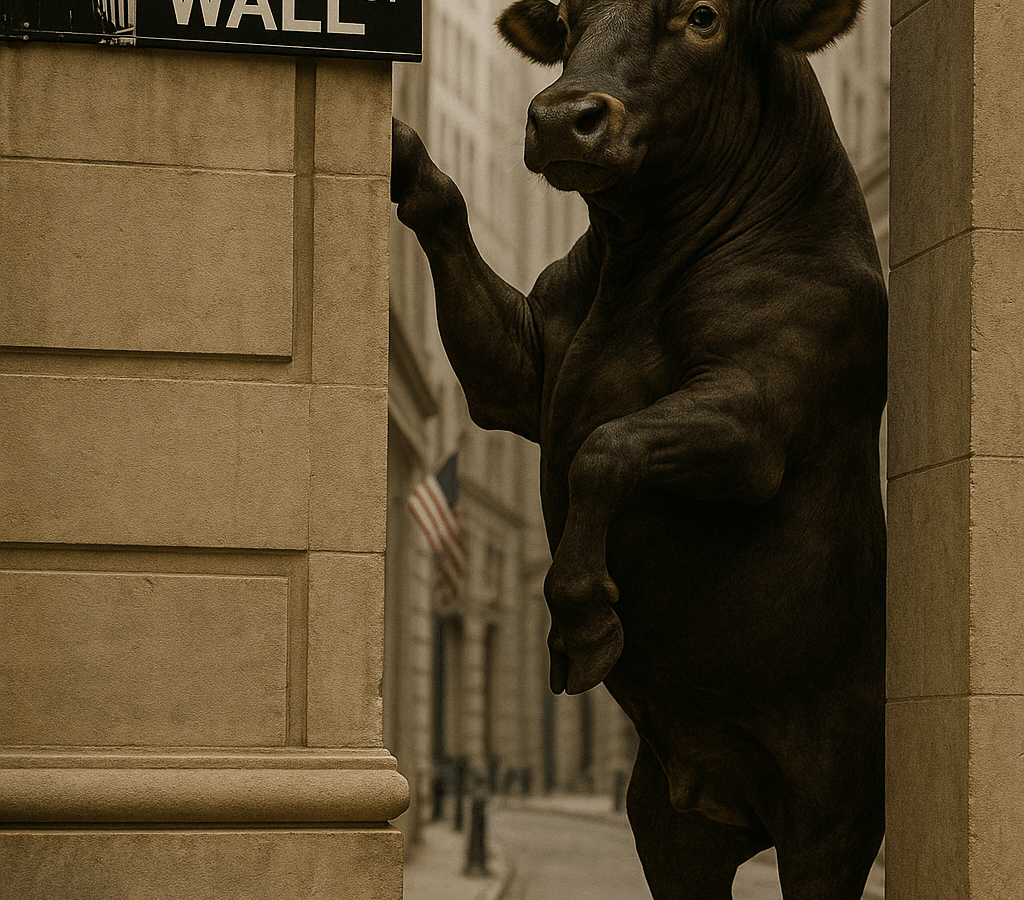
I entered 2025 with a cautious outlook, and uncertainty with the White Policy was clouded! And they still are! But the market has taken a worst-case scenario. The stock market’s performance through mid-July has forced a reckoning. U.S. equities have powered to fresh highs this year, defying fundamental concerns and confounding those (like us) who expected a pullback. Rather than rolling over, the S&P 500 and other indices extended their gains in the second quarter, fueled by a potent mix of momentum and investor psychology. In hindsight, our bearish call was wrong, at least in timing. The rally’s persistence illustrates how market behavior can trump macro fundamentals and policy over meaningful periods.
What drove this relentless rise? In a word: FOMO – the fear of missing out – combined with institutional positioning dynamics. I have analyzed(below), underexposed investors, performance anxiety, and herd behavior have collectively overwhelmed the negatives I was worried about. I examined these drivers and why little on the immediate horizon appears likely to break the uptrend, barring an unforeseen shock. We also outline realistic risk scenarios that could eventually snap the streak, even if the next 1–3 months continue to reward risk-taking. Our goal is to provide an assessment for investors of how sentiment and positioning have upended a bearish thesis, and what that means going forward.
Underweight Institutions and Performance Anxiety
One key fuel for the rally is the positioning of big institutional investors. Coming into the summer, many asset managers were underweight equities – especially U.S. stocks – by historically large margins. The June Bank of America Fund Manager Survey, for example, showed a net 36% underweight to U.S. equities, one of the most bearish stances in decades. In other words, fund managers collectively had far less exposure to the U.S. market than their benchmarks, reflecting the skepticism and caution that prevailed earlier in the year. But as the market kept rising, that underweight became a liability. Every tick higher meant these managers trailed their performance targets more, putting their careers and bonuses at risk.
Performance anxiety is a powerful motivator. With many mutual funds and institutional strategies measured against the S&P 500 – and with fiscal year-ends approaching this fall for a large portion of funds – underperformers are under intense pressure to catch up. October 31 marks the year-end for most U.S. mutual funds, meaning there are only a few months left for lagging managers to make their numbers. This dynamic creates a classic late-year “chase”: those who were defensively positioned are forced to buy into the rally simply to avoid falling further behind their benchmark. The result is an involuntary demand for equities, particularly the big index heavyweights, as institutions try to close the gap.
Importantly, this isn’t a fundamentally driven shift – it’s career-risk driven. Fund managers are effectively asking themselves, “Can I afford to keep missing this rally?” For many, the answer is no. The institutional underweight that once reflected prudent caution has flipped into a source of risk: underexposed funds are now piling in out of fear of underperforming peers and benchmarks, adding more fuel to the uptrend. In Wall Street parlance, the pain trade (the scenario that hurts most people) has been up, not down. And we are seeing exactly that play out.
Underweight Funds + Bonus-Driven Buying = Relentless Demand
- BofA’s Fund Manager Survey puts U.S. equity underweight at ~38%—one of the lowest ever recorded.
- With the fiscal year-end approaching in October, managers underperforming benchmark returns are desperate to catch up.
- That means they won’t sell into strength—they’ll buy dips and likely add exposure to outperforming AI/multinational names to protect bonuses.
Human factor: career pressure = forced buyer. Nobody wants to lag benchmarks when bonuses are on the line.
FOMO, Momentum, and the Psychology of a Rally
It’s not just institutional buyers catching up. Retail investors and momentum traders have embraced a risk-on mindset, amplifying the rally far beyond the safest blue chips. The market that confounded us fundamentally has been underpinned by a speculative fervor and FOMO across the board. As one strategist observed, a “fear of missing out appears to be a key force behind recent investor behavior”. In practice, this has meant aggressive buying of anything with high beta or a catchy narrative.
Market internals tell the story. The surge has broadened to many corners of the equity universe – often the least fundamentally sound corners. Nearly 420 stocks in the Russell 3000 index jumped more than 50% between the early-April lows and late June, yet only 4 of those companies were profitable. In that span, unprofitable companies’ stocks soared an average of 36%, more than double the 15.6% return of the stocks with the lowest price-to-earnings ratios. In other words, the rally has been led by lower-quality, high-risk names – the kind of price action one sees when momentum and speculation trump fundamentals. Meme-stock favorites like Palantir and the most heavily shorted names (e.g. Super Micro Computer) became top performers. Even penny stocks and recent IPOs have skyrocketed. This “lower quality tilt” is a hallmark of a FOMO-driven market, with investors chasing anything that is moving.
Such behavior tends to feed on itself. Success breeds complacency: as more traders profit from speculative bets, more jump in. Market veterans are warning that “some complacency has crept in”. The Cboe Volatility Index (VIX), Wall Street’s fear gauge, recently fell to around 16 – its lowest readings since early 2024 – reflecting a remarkable level of investor confidence. This contrasts starkly with the spiking to over 50 on the VIX back in April during a tariff scare. The swing from fear to complacency has been swift. Likewise, sentiment surveys have flipped from pessimism to optimism: measures like the AAII retail sentiment poll and Morgan Stanley’s Risk Demand Index, which were flashing deep caution in April, are now showing “a lot of optimism – maybe not euphoric, but on its way,” as one fund manager noted.
All of this reflects a powerful psychological momentum in the market. Investors who earlier “de-risked” are now worried about missing further gains and are scrambling back in, which in turn pushes prices higher and validates the optimism. It’s a classic feedback loop. As Steve Sosnick of Interactive Brokers put it, “MOMO and FOMO are likely to dominate until proven otherwise”. We underestimated how strong this loop could become. Our bearish outlook was predicated on fundamentals (e.g. high valuations, peaking growth, various risks), but fundamentals don’t matter – at least for now – when momentum takes over. In hindsight, it’s clear that herd behavior and fear of missing the rally were far more potent forces in recent months than any of the warning signs we cited.
Fund Flows & Retail & FOMO = Fuel to Drive Momentum
- JPMorgan sees a $500 billion “wall of money” ($360 b retail, plus ETFs and systematic funds) pouring in from July onward.
- Retail and tech fund flows surged last week with $1.7 b to tech funds, despite minor overall equity fund inflows.
- Speculative, retail-driven FOMO is alive and well, with sentiment metrics in “extreme greed” territory.
Human factor: greed begets greed—once funds begin chasing, they reinforce the rally.
Why the Uptrend Is Likely to Hold (For Now)
Looking ahead to the next 1–3 months, we must ask: what, if anything, will break this uptrend? Absent a major shock, the path of least resistance remains upward. The same factors described above are still in play and could even intensify. Institutional portfolios are still not fully positioned for a bull market, despite some recent buying, fund managers remain deeply underweight U.S. equities and heavily overweight cash and international stocks. That leaves plenty of potential buying power on the sidelines. Many hedge funds and allocators will be loath to bet against a market that refuses to go down, especially as their year-end scorecards approach. Many fiscal years end in October, and compensation for fund managers often hinges on relative performance. This creates a powerful incentive to maintain or increase equity exposure into the fall, rather than risk missing a continued rally. In short, professional investors are effectively conditioned to buy dips and grind the market higher, at least through the fiscal year finish line.
Meanwhile, corporate earnings – a potential catalyst for downturns in a typical cycle – don’t appear to pose much threat this quarter. We can largely dismiss earnings as a negative catalyst in the near term. With the U.S. dollar in a steady downtrend (the dollar index has fallen nearly 11% this year, hitting its lowest level in over three years), American multinationals are enjoying a currency tailwind. Weaker dollar = stronger translated overseas revenues, which should buoy S&P 500 earnings rather than hurt them. Many companies will likely beat estimates or guide in-line, helped by this forex boost. The market has also been priced in a Goldilocks narrative of peaking inflation and the prospect of eventual Federal Reserve rate cuts. Barring an ugly surprise, the coming earnings season and central bank meetings are more likely to reinforce the bullish narrative (or at least not disrupt it) than to shatter it. Indeed, recession fears that loomed large earlier have markedly receded – “soft landing” expectations are the strongest since late 2024. There is a general sense that the economy can slow gently without crashing, giving cover for inflation to ease and policymakers to be accommodative. That benign backdrop is exactly what bullish investors want to hear.
Given current market internals and positioning, a dramatic trend reversal seems unlikely in the immediate term. Breadth has broadened somewhat in recent weeks, with previously lagging sectors and small-caps showing signs of life (for instance, small-cap indices outperformed in early July, improving breadth modestly). And with volatility so low, systematic strategies like risk-parity funds or volatility-targeting funds are probably adding equity exposure, mechanically buying as realized volatility falls. Even short sellers have been squeezed, and many have covered positions as stocks grind higher – removing what was another potential source of selling. All told, the momentum buyers outweigh any profit-takers right now. Each minor dip finds support from those who feel they missed the last rally leg. This self-reinforcing dynamic will likely continue over the next few months unless an exogenous shock snaps investors out of complacency.
Earnings Tailwind + Dollar Drag Helps Multinationals
- Earnings season is shaping up “better than feared,” bolstered by a weakening dollar (~10% YTD).
- Institutional money will rotate into AI and multinational leaders, reinforcing the trend.
- Unless any large issuers are disappointed, even a flat report could spark more buying as funds chase returns.
Human factor: underweight managers don’t wait for perfect—they jump on anything that supports the narrative.
What Could Break the Momentum?
While the base case for the next quarter remains bullish, we would be remiss not to consider what realistic risks could change sentiment. It’s important to stress that none of these are our base-case expectations, but any of them could materialize and rapidly flip the script, given the stretched sentiment. Here are a few scenarios to watch:
- Policy or Inflation Shock: The market is currently priced for perfection regarding the Fed and inflation – assuming the next moves are rate cuts into a benign slowdown. If instead we get a hot inflation print or a hawkish policy surprise (for example, the Fed signaling no cuts well into 2026), it could jolt investors out of the soft-landing dream. Rising oil or wage pressure could quickly revive inflation fears. A reminder that the Fed’s job is not done would pressure the high-valuation growth stocks leading the charge.
- Trade War or Geopolitical Escalation: Thus far, markets have shrugged off tariff threats and even war headlines. As one analyst noted, the market’s “apparent indifference” to things like President Trump’s new 50% tariff on copper imports shows a desensitization to risk. Investors are behaving as if every flare-up will be resolved in due time. But imagine a further escalation – say a broader trade war that meaningfully impacts supply chains or a geopolitical shock (e.g., a Middle East conflict or renewed tensions in East Asia) that cannot be ignored. In a complacent market, the reaction to a true negative surprise can be severe because few are hedged for it. As one portfolio manager put it, “the market is getting used to crying wolf, and that desensitization is itself a risk.” A real wolf – a serious adverse event – could spark a rush for the exits.
- Credit or Liquidity Crunch: Financial conditions have eased with rising markets, but they could tighten abruptly. One risk is the ongoing reversal of liquidity: with the U.S. debt ceiling resolved, the Treasury is issuing bonds again and drawing cash out of the system (refilling its Treasury General Account). This is happening behind the scenes and could eventually drain the excess liquidity that helped equities. Additionally, credit spreads are near historic tights – any surprise default or stress in credit markets could widen spreads and send a risk-off ripple through equities. A large corporate bankruptcy or a crack in the high-yield market might be such a catalyst. If investors suddenly must contend with rising default risk or lack of financing, the equity sentiment could sour quickly.
- Overcrowded Longs and Sentiment Reversal: Finally, the very speed of this rally could become its Achilles’ heel. Everyone piling into the same popular trades (mega-cap tech, AI-related names, etc.) sets up a situation where any hint of disappointment leads to a sharp air-pocket. We are already seeing extremely bullish positioning in certain areas – at some point, buyers get exhausted. If, for example, a couple of marquee tech companies reported weak guidance (even if overall earnings aren’t a disaster) or if economic data shows a sharper slowdown than expected, the mood could shift from greed to fear abruptly. With sentiment indicators now flashing optimism, there is less “wall of worry” to climb. A market without worry is more vulnerable to panic when the unexpected hits.
In sum, these are the kinds of developments that could break momentum. Crucially, they all represent a change in narrative or a shock to the complacency. The rally’s foundation is the assumption that everything will go just right – gentle economic slowdown, falling inflation, eventual rate cuts, no major geopolitical or credit disruptions. As one investor quipped, “There’s a lot that needs to go just right” for this rosy scenario to hold. Should one of those things go wrong, the market could finally react. For now, however, none of these risks appear imminent in the very short term, which is precisely why the rally has been so resilient. We will be watching closely for any cracks in the consensus narrative.
Summary TLDR: Early, Not Wrong (But Staying Vigilant)
In retrospect, my bearish outlook was early, driven by concerns that, while valid, have been steamrolled by the market’s near-term psychology. We underestimated the sheer force of group behavior and career incentives in driving asset prices. The continued rally through mid-July 2025 has proven that being fundamentally right at the wrong time just means you’re wrong in the eyes of the market. As of now, the bulls have the upper hand, and fighting that trend (as we did) has been a mistake. We acknowledge that our caution was misplaced for this phase of the cycle.
That said, we are not throwing fundamental analysis out the window – we are adjusting our timeframe. The market’s behavior reminds us of late-stage rallies of the past: rich valuations propelled even higher by FOMO, increasing concentration in a few names, and a narrative of “this time is different” taking hold. Such rallies can persist longer than skeptics expect – especially when fueled by underinvestment and performance chasing – but they do not last forever. Our resolve is to participate judiciously in the uptrend (given that it remains intact for now) while staying vigilant for signs of a sentimental turn. When virtually everyone becomes bullish and fully invested, that’s when the risk of a sharp reversal will be highest. We aren’t there yet; skeptics still exist, and some money remains on the sidelines, which suggests the current momentum can carry further in the coming months.
The takeaway is twofold. First, recognize the power of the herd: the rally’s strength is rooted in behavioral finance dynamics – fear of missing out, benchmark-driven buying, and the self-reinforcing cycle of rising prices. These can dominate until an inflection point is reached. Second, plan for that inflection point even as you ride the wave. It is possible – even logical – to remain tactically bullish given the trend and positioning backdrop, while also preparing for the inevitable moment when the music stops. That means keeping an eye on measures of euphoria, monitoring for deteriorating internals (e.g. if breadth suddenly narrows or defensive assets start to strengthen), and having a risk management plan for when momentum fades.
In conclusion, our previous bearish view has been invalidated in the short run by an uptrend that feeds on its own success. We admit that and have adjusted our stance. The current rally may very well extend through the next quarter as institutional underweights are unwound and FOMO runs its course. Absent a shock, momentum and sentiment should carry this market higher into early autumn. But we will not lose sight of the eventual risks gathering just outside the spotlight. Momentum, after all, works both ways. For now, the trend is our friend – but when the crowd eventually swings from greedy to fearful, we intend to be one step ahead, not caught on the wrong side again.
Based on human behavior, underweight positioning, and ongoing momentum, the rally is highly likely to continue through August, though not without choppy price action.
Watch for These Immediate Triggers
- Tariff headlines (e.g., copper tariffs) could create short-lived spikes.
- Jackson Hole tone — dovish reaffirmation supports, but hawkish surprise could shake faint-hearted sellers (my largest short-term fear).
- Temporary tech rotation — after strong gains, some non-AI money may pause—yet dip-buyers likely step in.
Final Stance: Yes, the rally should continue through August. Human greed, bonus-driven demand, and momentum buying are driving forces. While not without volatility, the behavioral dynamics suggest dips will be purchased, not sold.
IMPORTANT LEGAL DISCLAIMER
READ THIS DISCLAIMER CAREFULLY BEFORE USING THIS FINANCIAL NEWSLETTER
No Investment Advice
This newsletter is provided for informational and educational purposes only and does not constitute investment advice, financial advice, trading advice, or any other sort of advice. The content is not intended to be a substitute for professional financial advice. You should not rely on this newsletter as the sole basis for any investment decision.
No Fiduciary Relationship
The publication of this newsletter does not create any fiduciary relationship between the publisher and readers. We are not acting as your investment advisor, financial planner, or in any fiduciary capacity with respect to your investments or financial decisions.
Market Risk Warnings
ALL INVESTMENTS INVOLVE THE SUBSTANTIAL RISK OF LOSS. Past performance is not indicative of future results. The value of investments can go down as well as up, and you may lose some or all of your invested capital. Market conditions, economic factors, and company-specific events can significantly impact investment values.
Specific risks include, but are not limited to:
- Market volatility and systematic risk
- Currency fluctuation risk for international investments
- Interest rate risk
- Credit risk and default risk
- Liquidity risk
- Inflation risk
- Regulatory and political risk
- Sector-specific and company-specific risks
Forward-Looking Statements
This newsletter may contain forward-looking statements and projections that are based on current expectations, estimates, and assumptions. These statements are subject to significant uncertainties and actual results may differ materially from those expressed or implied. Forward-looking statements should not be relied upon as predictions of future events.
No Guarantee of Accuracy
While we strive to provide accurate and up-to-date information, we make no representations or warranties regarding the accuracy, completeness, or timeliness of any information contained in this newsletter. Information may become outdated, and we are under no obligation to update or correct any information.
Independent Research Required
You are strongly encouraged to conduct your own research and due diligence before making any investment decisions. Consult with qualified financial professionals, including licensed investment advisors, tax professionals, and attorneys, who can provide advice tailored to your specific financial situation and investment objectives.
No Liability
To the fullest extent permitted by law, the publisher, authors, contributors, and affiliated parties disclaim all liability for any direct, indirect, incidental, consequential, or punitive damages arising from your use of this newsletter or any investment decisions made based on its content.
Conflicts of Interest
The publisher, authors, or contributors may have financial interests in securities mentioned in this newsletter. We may buy, sell, or hold positions in any securities discussed without prior notice to readers. This newsletter may be sponsored by or contain promotional content for financial services companies.
Regulatory Compliance
This newsletter has not been reviewed or approved by the Securities and Exchange Commission (SEC), Financial Industry Regulatory Authority (FINRA), or any other regulatory body. This newsletter is not an offer to sell or a solicitation to buy any securities.
Geographic Limitations
This newsletter is intended for distribution to residents of the United States only. International readers should consult local laws and regulations before acting on any information contained herein, as securities laws vary by jurisdiction.
Age and Capacity Requirements
This newsletter is intended for use by individuals who are 18 years of age or older and have the legal capacity to enter financial transactions. Minors and individuals lacking legal capacity should not rely on this information.
Data Sources and Third-Party Information
Information in this newsletter may be derived from third-party sources that we believe to be reliable, but we do not guarantee the accuracy of such third-party information. We are not responsible for any errors or omissions in third-party data.
Limitation of Warranties
THIS NEWSLETTER IS PROVIDED “AS IS” WITHOUT ANY WARRANTIES OF ANY KIND, EXPRESS OR IMPLIED, including but not limited to warranties of merchantability, fitness for a particular purpose, or non-infringement.
Indemnification
By using this newsletter, you agree to indemnify and hold harmless the publisher, authors, contributors, and affiliated parties from any claims, damages, losses, or expenses arising from your use of the information or any investment decisions made based on such information.
Modification of Terms
We reserve the right to modify this disclaimer at any time without prior notice. Your continued use of this newsletter constitutes acceptance of any such modifications.
BY READING AND USING THIS NEWSLETTER, YOU ACKNOWLEDGE THAT YOU HAVE READ, UNDERSTOOD, AND AGREE TO BE BOUND BY THE TERMS OF THIS DISCLAIMER.