
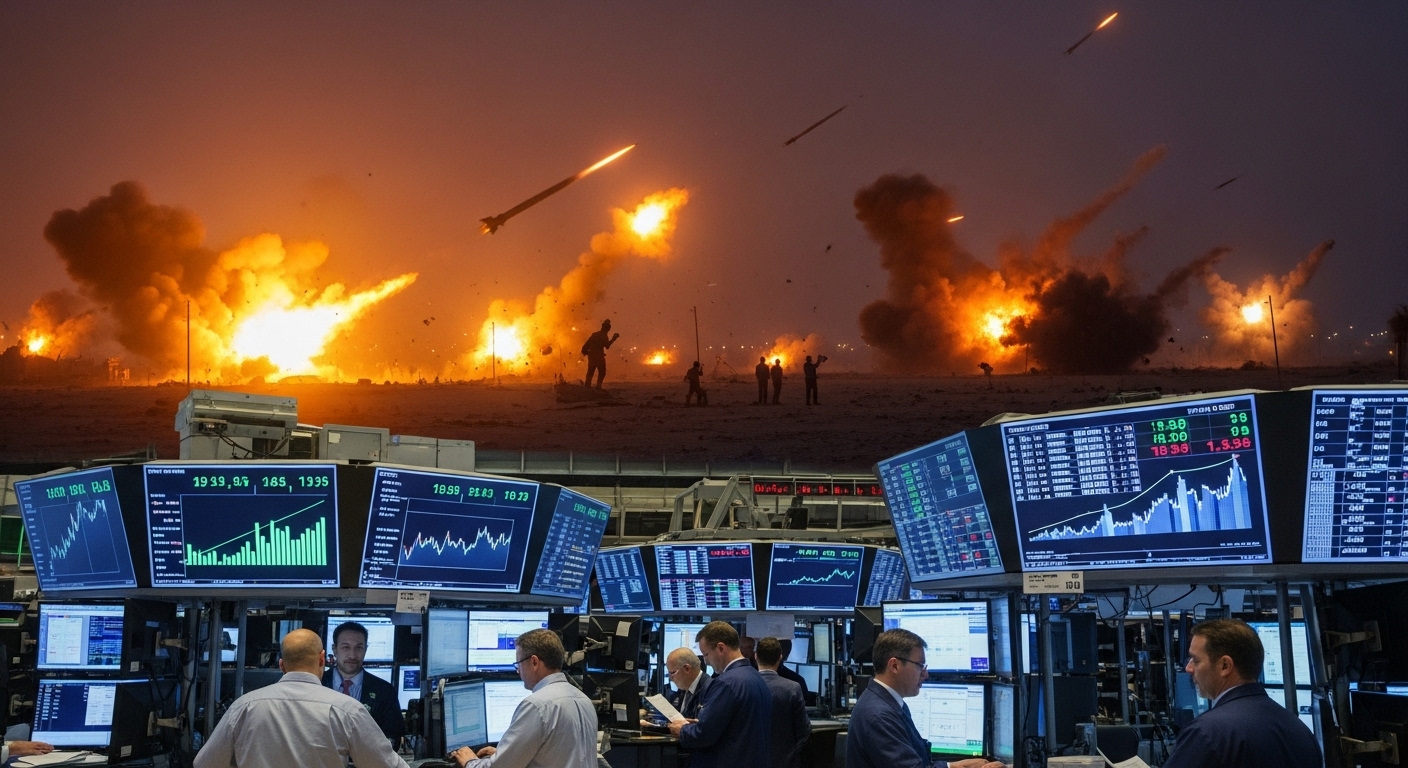
The escalating tensions in the Middle East present a complex web of risks for equity markets that extends far beyond traditional oil price shocks. While supply chain disruptions have not materialized as some analysts had feared earlier in the war, a spike in oil prices would carry significant implications for the U.S. economy. With the S&P 500 experiencing unprecedented volatility in 2025, investors face a perfect storm of geopolitical uncertainty, tariff-induced inflation, and a bond market that’s abandoning its traditional safe-haven role. This analysis examines the multi-faceted risks and provides actionable intelligence for navigating what could be the most challenging market environment since the 2008 financial crisis.
The Short-Term Outlook: A 3-Month Pressure Cooker
Immediate Market Dynamics
The stock market’s response to Middle East tensions has followed a predictable pattern, but with concerning deviations. The S&P 500 (SPX), opens new tab, was down 0.9% while the Nasdaq Composite Index was off 1.6% during recent escalations, though history suggests these initial reactions often reverse quickly.
We also know that looking back at conflicts since 1925—including the Korean War, Vietnam, the Cuban Missile Crisis, the Iran-Iraq War, two U.S. wars in Iraq, and so on—it was only World War II that resulted in a bear market. However, current market conditions differ significantly from historical precedents due to:
- Elevated Valuations: With the S&P 500 near all-time highs before recent volatility, the market has limited cushion for geopolitical shocks.
- Tariff Complications: Unlike previous conflicts, we’re dealing with simultaneous trade wars that amplify market uncertainty.
- Bond Market Dysfunction: The traditional flight to safety isn’t working as expected.
Oil Price Trajectories and Market Impact
Goldman Sachs analysts estimate the conflict could temporarily knock out 1.75 million barrels per day of Iranian supply over six months, only partially offset by increased output from other producers inside the Organization of Petroleum Exporting Countries and its allies (OPEC+). Their models suggest “We estimate that Brent jumps to a peak just over $90/bbl but declines back to the $60s in 2026 as Iran supply recovers”.
The ripple effects would be immediate:
- Transportation Sector: Airlines and shipping companies face margin compression.
- Consumer Discretionary: Higher fuel costs reduce disposable income.
- Manufacturing: Energy-intensive industries see profit margins erode.
The Inflation-Tariff Nexus: A Double-Edged Sword
Current Tariff Impact on Markets
The Trump administration’s aggressive tariff policies have created a new layer of market complexity. J.P. Morgan Research has lowered its estimate for 2025 real GDP growth due to heightened trade policy uncertainty, the effect of existing tariffs and retaliatory measures by foreign trading partners. Specifically, Real GDP growth is now expected to be 1.6% for the year, down 0.3% from previous estimates.
The Compound Effect: Oil Plus Tariffs
When you combine potential oil shocks with existing tariff pressures:
- Inflation Acceleration: PCE price inflation for 2025 is expected to climb to 2.7%, up 0.2 percentage points, while core PCE inflation is forecast to increase 0.3 percentage points to 3.1%.
- Fed Policy Paralysis: The Federal Reserve faces an impossible choice between fighting inflation and supporting growth.
- Corporate Earnings Compression: Barclays strategists estimate that the tariffs could lead to a 2.8% drag on S&P 500 company earnings, including the projected fallout from retaliatory measures from the targeted countries.
Transportation and Consumer Impact Analysis
A sustained oil price spike would create cascading effects through the economy:
- Gasoline Prices: De Haan told CNN that gasoline prices are likely to drift higher over the next few weeks, increasing by about 10 to 25 cents per gallon.
- Supply Chain Costs: Every $10/barrel increase in oil adds approximately 2-3% to transportation costs.
- Consumer Behavior: Historical data shows consumer spending drops 0.5% for every 10% increase in fuel costs sustained over 3 months.
Presidential Response: The X-Factor in Market Stability
The “Unhinged” Scenario and Market Psychology
Market stability increasingly depends on executive branch messaging. The April 2025 market crash demonstrated how policy uncertainty can trigger massive selloffs. The Associated Press described it as a “freak” sell-off and highlighted experts who attributed it to a loss of confidence among investors in the United States as a safe, stable place to store money.
Key risk factors from erratic presidential responses:
- Volatility Amplification: “Markets hate uncertainty, and nearly every statement coming out of the White House is either very vague or completely devoid of detail.”
- International Confidence Crisis: Allied nations’ trust in U.S. leadership affects dollar strength and Treasury demand.
- Policy Whiplash: The April tariff reversal showed how market pressure can force sudden policy changes.
International Trust Deficit
The erosion of international confidence manifests in several ways:
- Dollar Weakness: Despite typical safe-haven flows, the dollar has shown unusual weakness during crises.
- Allied Coordination Breakdown: Traditional G7 cooperation mechanisms are strained.
- Trade Partner Retaliation: Escalating tit-for-tat measures amplify market uncertainty.
The Bond Market’s Opposite Reaction: A Seismic Shift
Friday’s Anomaly and Its Implications
The most alarming development has been the bond market’s abandonment of its traditional safe-haven role. After Trump announced sweeping tariffs on dozens of US trading partners on April 2, investors began selling off longer-maturity US Treasuries in large quantities, sending yields sharply higher. The sell-off came in spite of huge losses in the US stock market, bucking the usual pattern of investors rushing to assets typically deemed to be safe havens.
This represents a fundamental shift in market dynamics:
- Correlation Breakdown: Stocks and bonds falling together eliminates traditional portfolio hedging.
- Funding Stress: Hedge funds typically borrow from the repo market to buy Treasuries and use the latter as collateral. Falling prices of Treasuries due to the selloff provided less collateral value for borrowing, prompting margin calls.
- Foreign Seller Concerns: Questions about whether China and other major holders are reducing Treasury positions.
Why Everyone Is Selling U.S. Assets
The shift away from U.S. assets reflects multiple concerns:
- Fiscal Sustainability: The poor demand means that investors who lend money to the United States think the Trump agenda, in particular, the “Big, Beautiful” tax cut bill, has made America an unacceptably risky investment.
- Inflation Expectations: Tariffs plus fiscal stimulus create stagflation fears.
- Geopolitical Realignment: Countries seeking alternatives to dollar-denominated assets.
Comprehensive Risk Assessment and Portfolio Positioning
Scenario Analysis
Best Case (30% probability):
- Middle East tensions remain contained to the current participants
- Oil prices stay below $80/barrel
- Tariffs are negotiated down from initial levels
- Market impact: 5-10% correction, then recovery
Base Case (50% probability):
- Limited regional escalation
- Oil spikes to $85-90, then moderates
- Tariffs partially implemented
- Market impact: 15-20% correction, choppy recovery
Worst Case (20% probability):
- Iran directly enters conflict
- Oil exceeds $100/barrel
- Full tariff implementation triggers global recession
- Market impact: 25-35% bear market
Possible Portfolio Strategies
- Reduce Overall Equity Exposure: Target at least 15-20% cash position
- Sector Rotation: (if desired)
- Overweight: Energy, Defense, Utilities
- Underweight: Consumer Discretionary, Airlines, Retail
- Geographic Diversification: Reduce home bias, consider gold and commodity producers
- Fixed Income Positioning: Shorten duration, consider TIPS and floating rate notes
- Alternative Assets: 5-10% allocation to managed futures and market-neutral strategies
Hedging Strategies (for the experts)
- Oil Price Hedges: Consider energy sector ETFs or oil futures for portfolios heavily exposed to transportation costs
- Currency Hedges: Given dollar uncertainty, consider a basket of G10 currencies
- Volatility Protection: VIX calls or put spreads on major indices
Institutional vs. Retail: The Psychology of Crisis Response
Institutional Investor Psychology: The Professional Panic
Institutional investors—hedge funds, pension funds, mutual funds, and sovereign wealth funds—operate under unique psychological pressures that will likely drive predictable behaviors in this crisis:
Phase 1: Risk Reduction (Days 1-5)
- Algorithmic Deleveraging: Quantitative funds will trigger systematic risk reduction as volatility spikes. Expect coordinated selling in the first 48-72 hours as risk parity funds mechanically reduce positions
- Margin Call Cascade: Prime brokers will issue margin calls on leveraged positions, forcing funds to sell liquid assets (including Treasuries) to meet requirements
- Window Dressing: Quarter-end considerations will accelerate selling as managers protect performance metrics
Phase 2: Repositioning (Days 5-20)
- Sector Rotation: Smart money will rotate into energy and defense while dumping consumer discretionary and financials
- Geographic Reallocation: Expect flows out of emerging markets (except commodity producers) into Japanese yen and Swiss franc
- Derivative Positioning: Large increases in put buying and VIX futures positioning as institutions hedge remaining exposure
Phase 3: Opportunistic Re-entry (Days 20-60)
- Value Hunting: Distressed debt funds and value-oriented institutions will begin selective buying at 20-25% discounts
- Vol Selling: As VIX spikes above 40, institutions will begin selling volatility for income
- Carry Trade Unwind: Watch for yen strength as $1+ trillion in carry trades unwind
Most Likely Institutional Behavior Pattern: Institutions will initially overreact, driving indices down 8-12% in the first week, before stabilizing. The key difference from retail: they’ll begin buying back in while retail is still selling, typically around the 15-20% drawdown level.
Retail Investor Psychology: The Emotional Rollercoaster
Retail investors face a devastating combination of emotional triggers that create predictable—and exploitable—patterns:
Stage 1: Denial and Hope (Current Stage)
- “Buy the Dip” Mentality: Initial 5% decline will see retail buying, remembering recent V-shaped recoveries
- Social Media Echo Chambers: Reddit and Twitter will reinforce confirmation bias with “diamond hands” messaging
- FOMO Persistence: Fear of missing the rebound keeps retail engaged despite warning signs
Stage 2: Anxiety and Paralysis (5-10% Decline)
- Account Checking Obsession: Daily/hourly portfolio monitoring increases anxiety
- Information Overload: Consuming contradictory news creates decision paralysis
- Hope for Presidential “Save”: Retail clings to belief that government intervention will rescue markets
Stage 3: Panic and Capitulation (15-20% Decline)
- 401(k) Liquidation: Mass movement to cash/money markets near the bottom
- Meme Stock Collapse: Highly speculative positions face 60-80% losses, triggering broader selling
- Margin Call Disasters: Leveraged retail traders forced out at maximum loss
Stage 4: Despair and Disengagement (20%+ Decline)
- Complete Risk Aversion: Retail swears off stocks “forever”
- Conspiracy Theories: Blame shifts to “manipulation” and “rigged markets”
- Missing the Recovery: Retail remains in cash during the initial rebound
Most Likely Retail Behavior Pattern: Retail will hold through the first 10% decline, begin panic selling at 15%, and completely capitulate between 20-25% down, precisely when institutions start buying. Studies show 85% of retail investors will sell within 10% of a bear market bottom.
The Psychological Arbitrage Opportunity
The divergence between institutional and retail psychology creates specific opportunities:
- Days 1-10: Institutions sell, retail buys → Fade retail optimism
- Days 10-30: Both selling → Maximum downside momentum
- Days 30-60: Institutions buy, retail sells → Follow institutional flow
- Days 60+: Institutions positioned, retail sidelined → Rally without retail
Manipulation and Messaging: The Information War
Institutional Advantages:
- Direct access to company management
- Sophisticated news filtering algorithms
- Professional network information flow
- Ability to move markets with positioning
Retail Disadvantages:
- Delayed information via financial media
- Emotional manipulation through headlines
- Influencer pump-and-dump schemes
- Broker platform “technical difficulties” during volatility
Probable Psychological Outcomes
Best Case (30% probability):
- Institutions: 10-15% drawdown, quick reallocation, profit on volatility
- Retail: 15-20% losses, but stay invested, recover within 6 months
Base Case (50% probability):
- Institutions: 15-20% drawdown, successful hedging, breakeven by year-end
- Retail: 25-30% losses from poor timing, 18-month recovery period
Worst Case (20% probability):
- Institutions: 25-30% drawdown, but capture 50% of recovery
- Retail: 40-50% losses from panic selling, many never return to the markets
The Behavioral Edge: How to Think Like an Institution
- Pre-Program Responses: Decide selling levels NOW, before emotions engage
- Inverse Sentiment: When retail sentiment hits extreme fear, prepare to buy
- Volume Analysis: Institutional accumulation shows in unusual volume patterns
- Time Horizon Arbitrage: Think in quarters/years while retail thinks in days
- Volatility as Asset: Sell options when VIX > 35 instead of selling stocks
Warning: The Psychological Trap Timeline
- Week 1: “This is just a correction.”
- Week 2: “I should have sold last week.”
- Week 3: “I’ll sell on the next bounce.”
- Week 4: “Just get me back to even.”
- Week 6: “I can’t take it anymore” ← MARKET BOTTOM
- Week 8: “I’ll wait for confirmation” ← MISSES 20% RALLY
- Week 12: “Markets are rigged” ← PERMANENT LOSS LOCK-IN
The greatest edge in this market won’t be information—it will be psychological discipline. Institutions know this. Retail investors who recognize and resist these psychological patterns can capture institutional-quality returns.
Critical Warning Signs to Monitor
- Oil Infrastructure Attacks: Any targeting of Saudi, UAE, or Iranian facilities
- Strait of Hormuz Tensions: 20% of global oil transits through this chokepoint
- Presidential Rhetoric: Escalatory language regarding military options
- Bond Auction Failures: Weak demand at Treasury auctions signals funding stress
- Dollar Index Breaking Support: Sustained moves below 95 would signal crisis
- Retail Capitulation Indicators: Google searches for “sell 401k” spike, Robinhood outages
- Institutional Accumulation: Dark pool buying increases while prices fall
Conclusion: Navigating Uncharted Waters
The convergence of Middle East tensions, tariff wars, and fiscal concerns creates a uniquely dangerous environment for equity investors. Unlike previous geopolitical crises where U.S. assets provided shelter, today’s markets offer few safe harbors. The breakdown of traditional correlations means investors must abandon conventional wisdom and prepare for scenarios previously considered tail risks.
The prudent approach is defensive positioning while maintaining flexibility to capitalize on oversold conditions. This is not 2003 or 2011—the market structure, valuations, and policy environment create far greater downside risks. Prepare for volatility measured in months, not weeks.
IMPORTANT LEGAL DISCLAIMER
This financial newsletter and all information contained herein is provided for informational and educational purposes only and should not be construed as investment advice, a recommendation, or an offer to buy or sell any security or investment product.
NO INVESTMENT ADVICE: The information provided in this newsletter does not constitute investment advice, financial advice, trading advice, or any other sort of advice, and you should not treat any of the newsletter’s content as such. The author and publisher do not recommend that any investment decision be made based on this information.
PERFORMANCE DISCLAIMER: Past performance is not indicative of future results. All investments carry risk, and all investment decisions of an individual remain the responsibility of that individual. There is no guarantee that systems, indicators, or signals will result in profits or that they will not result in losses. All investors are advised to fully understand all risks associated with any kind of investing they choose to do.
FORWARD-LOOKING STATEMENTS: This newsletter contains forward-looking statements within the meaning of the Private Securities Litigation Reform Act of 1995. These statements are based on current expectations, estimates, forecasts, and projections about the markets and the securities discussed herein. These statements are subject to risks and uncertainties that could cause actual results to differ materially from those stated or implied by such forward-looking statements.
RISK DISCLOSURE: Trading and investing in securities involves substantial risk of loss and is not suitable for every investor. The valuation of securities may fluctuate, and as a result, you may lose more than your original investment. The past performance of a security or financial product does not guarantee future results or returns.
PROFESSIONAL ADVICE RECOMMENDED: Before making any investment decision, you should consult with qualified, licensed professionals, including but not limited to financial advisors, tax professionals, and legal counsel. The author and publisher strongly recommend that you perform your own independent research and due diligence before making any investment decision.
NO LIABILITY: Under no circumstances shall the author, publisher, or any affiliated parties be liable for any direct, indirect, incidental, special, or consequential damages arising out of or in connection with the use of this newsletter, including but not limited to trading losses, lost profits, or damages resulting from the use of or reliance on any information contained herein.
CONFLICTS OF INTEREST: The author and affiliated parties may hold positions in securities mentioned in this newsletter and may buy or sell such securities at any time. This represents a potential conflict of interest.
ACCURACY OF INFORMATION: While we strive to provide accurate and timely information, we make no warranties or representations about the accuracy, completeness, or timeliness of the information, analysis, and opinions provided. Market conditions change rapidly, and the analysis provided may become outdated quickly.
By reading this newsletter, you acknowledge that you have read and understood this disclaimer and agree to be bound by its terms.
By The Way (BTW)
The recent market move from the April low that decided not to trade, which was started by retail, is more than likely going to prove, I WAS CORRECT! IT WAS A BULL MARKET MOVE IN A BEAR MARKET. The next month or two should prove this. I don’t see this market setting a new high anytime soon. (It had numerous similarities to past Bull moves in Bear markets)
Here is the context:
Looking at market history, every bear market since 1901 has spawned at least one rally of 5% or more, with two-thirds of the twenty-one bear markets in that period featuring rallies of 10% or more. Perhaps the most notorious example occurred after the 1929 crash, when the Dow rebounded 48% over five months before ultimately declining 86% by 1932.
More recently, during the 2000-2001 Dotcom Crash, the NASDAQ experienced eight separate bear market rallies of at least 18%, including four that gained more than 30%, all of which proved temporary
So:
Don’t be surprised when I tell you again…I told you so!