
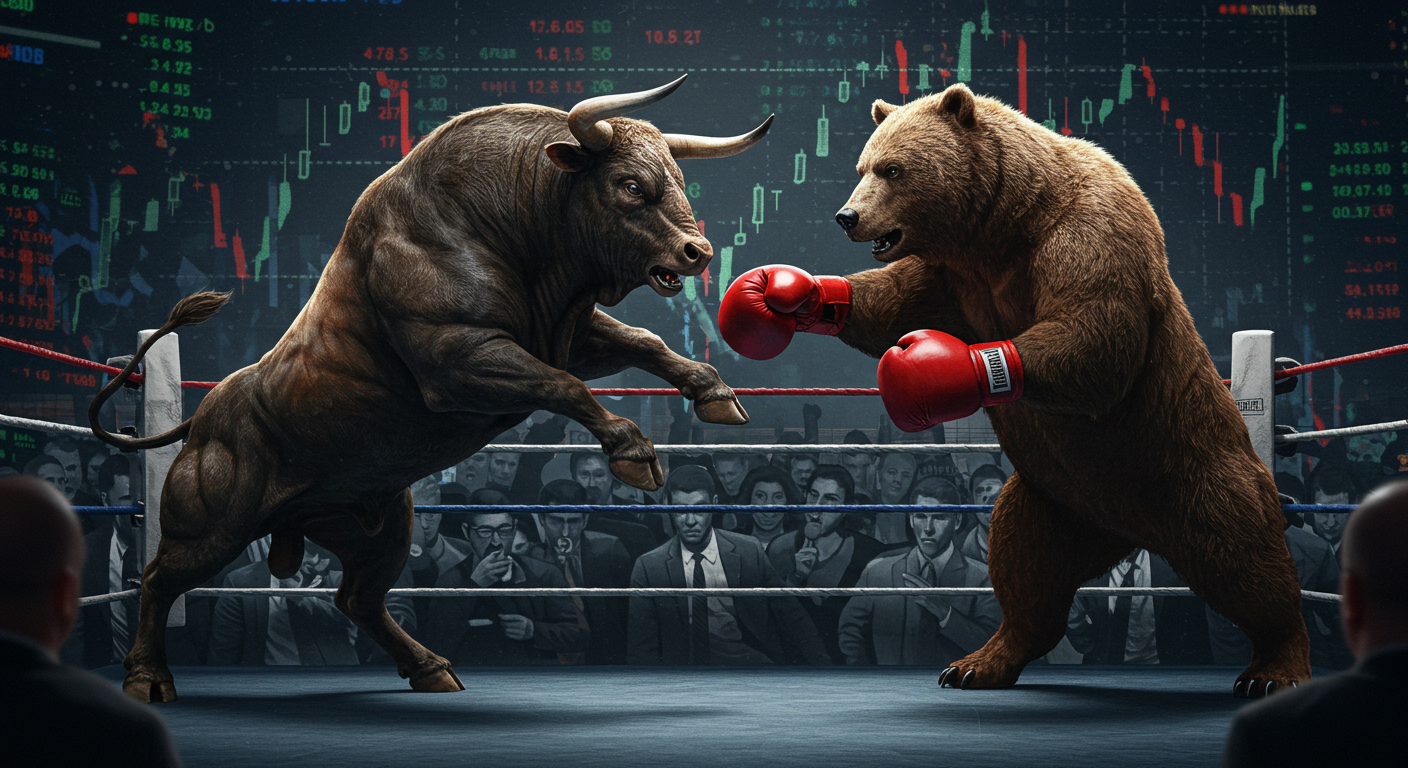
One has to admire the market’s sense of irony. Just when the wise and weathered veterans—armed with a thousand spreadsheets and the predictive powers of a crystal ball polished by decades of cynicism—confidently declare a “bull rally in a bear market,” the market decides to flip the script. (For now, things could change quickly.)
The initial call wasn’t wrong. In fact, it was dead-on: this rally wasn’t driven by Wall Street’s algorithmic elite or their bloated balance sheets. No, it was the retail crowd—the fearless foot soldiers of Reddit and Robinhood—charging headfirst into volatility. And to their credit, they were right. At least, until the algos noticed and piled in like it was a Black Friday sale on momentum trades.
And how do I know this? Easy. The brilliance of questioning why this rally happened—when it made absolutely no rational sense—runs in my bloodline. My son nailed it with brutal simplicity: “Dad, you always say don’t fight the tape.” And what did I do? I fought it. Lesson learned…I am a position trader looking for large gains over 6 months to 2 years. My son is a trend trader (in and out). He read it right. The trend is always your friend. I didn’t expect the rally to last this long. And now the market is fragile AGAIN. For those going long (in and out), it is important to watch the upcoming economic news on a daily basis. One bad report, like the ADP report, could sink your investment quickly, especially if it is followed up with another weak report. Which I suspect will happen shortly. Put 2 reports like that together, and you either get stuck in the stock or take a loss. So, PROCEED WITH CAUTION.
Yes, the market might push to new highs, but don’t confuse momentum with stability. This thing is fragile—duct tape and FOMO holding it together. Look no further than Wednesday’s ADP report: it came in weak, and the market flinched hard. Normally, no one even blinks at ADP. But that sudden selloff? That’s what fragility looks like.
So before you load up like it’s 2021, pause. Weakness is lurking just around the corner. Economic activity was likely front-loaded—people rushed to buy before tariff hikes kicked in (autos, appliances, etc.). Now comes the hangover.
Summer Buzz Word: Stagflation
Expect to hear one word repeatedly this summer: stagflation. Yes, it’s coming. But I don’t expect it to overstay its welcome. Why? Because the Fed, in its eternal wisdom, will likely ride to the rescue. Rate cuts are coming—probably sooner than Powell wants to admit—and if we’re lucky, they’ll call this inflation spike a “transitory” one-off, blamed on rising tariffs rather than a deeper supply-demand imbalance.
Bottom line: the tape still rules. But don’t be surprised if this summer’s buzzword turns into this fall’s buying opportunity.
Yet, as the rally stubbornly persisted, one couldn’t help but ponder the deeper machinations at play. Could it be that the hallowed halls of Wall Street, with their sophisticated models, had somehow validated this exuberance, perhaps by performing the very same tariff impact analysis that seemed to offer a silver lining? The market, after all, loves a good story, especially one backed by seemingly robust projections. However, as the latest economic reports land with the subtle grace of a lead balloon, it appears the plot has thickened considerably. The “unforeseen” – or perhaps, conveniently ignored – realities are now asserting themselves, suggesting that the market’s whimsical gyrations are due for a rather abrupt correction. This retrospective analysis aims to dissect the rally’s ephemeral charm and explain why its foundations were, shall we say, less than iron-clad. The inherent vulnerability of market predictions, no matter how seemingly insightful or well-reasoned at the time, is consistently exposed to the whims of complex, often contradictory, underlying forces. The temporary “brilliance” of an initial call often yields to the market’s inherent unpredictability, which systematically dismantles narratives built on incomplete information.
The Retail Revolution: Or, When the Crowd Knew Best (For a While)
The recent market ascent was, for a period, a testament to the sheer, unadulterated enthusiasm of the individual investor. It was observed that the rally was primarily being led by retail participants, a phenomenon not entirely unprecedented in market history. Consider the perennial “Santa Claus rally,” a festive surge often attributed to less institutional trading activity during the holidays, leaving the field open for typically more bullish retail investors.1 This historical context suggests that periods of heightened retail influence can indeed drive short-term market movements.
Supporting this observation, the S&P 500 experienced a notable rally, climbing over 6% in May 2025, with direct indications that this momentum was predominantly retail-led, while institutional investors largely remained on the sidelines.2 This dynamic is further amplified by the significant increase in retail investor participation in the market, which has surged to an impressive 25% post-pandemic, up from a pre-pandemic range of 10-15%.3 This growing footprint underscores the increased influence of this segment on overall market behavior.
However, the “why” behind this retail-driven surge often carries a subtle undercurrent of concern. Behavioral finance literature frequently characterizes these investors as “noise traders,” whose actions can be driven by emotion, speculation, or incomplete information, rather than meticulous fundamental analysis.4 Their trades, while powerful in aggregate, can temporarily push prices away from their intrinsic values.4 This stands in stark contrast to institutional investors, who are typically described as “informed investors” meticulously analyzing fundamental information and remaining cautious amidst lingering macro and earnings risks.2 The unfortunate reality, as historical data consistently shows, is that retail investors disproportionately suffer losses and have historically underperformed broader market indices, largely due to a perceived lack of “education” and access to advanced risk management tools.
Unstable Rallies Built on Enthusiasm Often Lead to Disappointment
The temporary triumph of collective enthusiasm over sober analysis, while entertaining, highlights a crucial point: a rally built primarily on sentiment and speculative buying, without the validating, sustained participation of informed investors, is inherently unstable. The growing disconnect between retail optimism and institutional caution serves as a critical warning. Such a rally, while potent in the short term, lacks a robust analytical foundation and becomes highly vulnerable to a sharp correction once underlying economic fundamentals or external shocks begin to assert themselves. The “retail revolution,” in this context, carries the seeds of its own potential undoing, as the initial surge lacks durable support.
So, before you take the plunge, tattoo this word on your investing psyche: stagflation. You’re going to hear it a lot this summer—on every financial network, in every analyst note, and probably from that guy at the gym who suddenly thinks he’s a macro strategist.
Thanks to tariffs quietly driving up prices, the data will start reflecting it. And yes, by textbook definition, we’ll be staring down the barrel of stagflation. Cue the financial media’s favorite pastime: panic. Fear sells, and fear moves markets. Expect a fresh wave of doom to send stocks reeling—again.
But here’s the reality check: if gas stays below $2.90 nationally, wage growth holds around 3.7%, and productivity hovers near 2%, then this version of stagflation is a shadow, not a storm. It’s a headline, not a hurricane.
And as I forecasted—on the record—back on March 5th, 2025, this is when Jerome “Superman” Powell will rip off the disguise and dive in to cut rates, all in the name of taming a stagflation scare. It won’t matter whether inflation is real or rhetorical—what matters is the Fed’s reaction.
That pivot? It sets the stage for a classic year-end rally. Again. You heard it here first.
Stock Pics
I have a load of new stocks to add to my list. I am just waiting for a better entry point. I will post them. So, check back.
IMPORTANT LEGAL NOTICE – READ CAREFULLY
NOT INVESTMENT ADVICE
The content provided herein is for EDUCATIONAL AND ENTERTAINMENT PURPOSES ONLY and does not constitute investment advice, financial advice, trading advice, or recommendations of any kind. Nothing in this commentary should be construed as a solicitation to buy or sell any security, investment product, or financial instrument.
NO PROFESSIONAL RELATIONSHIP
The author is not a licensed investment advisor, financial planner, broker-dealer, or registered investment advisor. No professional advisory relationship is created by reading this content. You should consult with qualified financial professionals before making any investment decisions.
PAST PERFORMANCE DISCLAIMER
Any references to past performance, predictions, projections, or forecasts are not indicative of future results. Investment returns and principal values fluctuate, and investments may be worth more or less than their original cost when redeemed. All investments carry the risk of loss.
SPECULATIVE NATURE
The commentary contains highly speculative opinions and forward-looking statements that are inherently uncertain. Market predictions, economic forecasts, and investment timing suggestions are based on personal opinion and limited information, not comprehensive analysis.
RISK WARNINGS
- ALL INVESTMENTS INVOLVE SUBSTANTIAL RISK OF LOSS
- Stock markets are volatile and unpredictable
- You may lose some or all of your invested capital
- Never invest money you cannot afford to lose
- Diversification does not guarantee profits or protect against losses
NO GUARANTEES
No representation or warranty is made regarding the accuracy, completeness, or timeliness of any information provided. The author makes no guarantees about investment outcomes or market performance.
PERSONAL RESPONSIBILITY
Investment decisions are your sole responsibility. You acknowledge that you are solely responsible for your own investment research and decisions. The author is not liable for any losses, damages, or adverse consequences resulting from reliance on this content.
CONFLICTS OF INTEREST
The author may hold positions in securities discussed and may trade in and out of positions without notice. The author’s personal trading activities may conflict with the opinions expressed.
REGULATORY COMPLIANCE
This content has not been reviewed or approved by any regulatory authority. It does not constitute an offer to sell or solicitation to buy securities in any jurisdiction where such an offer or solicitation would be unlawful.
LIMITATION OF LIABILITY
TO THE MAXIMUM EXTENT PERMITTED BY LAW, THE AUTHOR DISCLAIMS ALL LIABILITY FOR ANY DIRECT, INDIRECT, INCIDENTAL, CONSEQUENTIAL, OR PUNITIVE DAMAGES ARISING FROM YOUR USE OF THIS CONTENT, EVEN IF THE AUTHOR HAS BEEN ADVISED OF THE POSSIBILITY OF SUCH DAMAGES.
ACKNOWLEDGMENT
By reading this content, you acknowledge that you have read, understood, and agree to be bound by this disclaimer. If you do not agree with these terms, do not rely on this content for any investment decisions.